CVE-2026-112346: your AI agent's sandbox is a network service, and it shipped with no login
On 26 October 2026 a critical flaw was published for the OpenHands Software Agent SDK: CVE-2026-112346. It is not a flaw in a model. It is an ordinary default: a service that listens on every network interface and has no key set. What makes it worth a close read is what an agent sandbox contains.
This note is for you if you run coding agents through the SDK's Docker or Apptainer workspaces. Everything is as of 26 October 2026 and links to its source at the end.
The short version
- Affected: OpenHands Software Agent SDK before 1.52.0. Fixed in 1.52.0.
- The DockerWorkspace and Apptainer workspace launchers bind the sandbox agent server to 0.0.0.0 with an empty session_api_keys list, which disables authentication by default.
- Anyone who can reach the published port can send HTTP and WebSocket requests that run shell commands as root in the sandbox, reach the mounted workspace and read plaintext secrets from the secrets store.
- CVSS 3.1 9.8 (network, no privileges, no interaction). CVSS 4.0 9.3. CWE-1327, binding to an unrestricted IP address.
- The record does not report exploitation, and we have not read any exploit code.
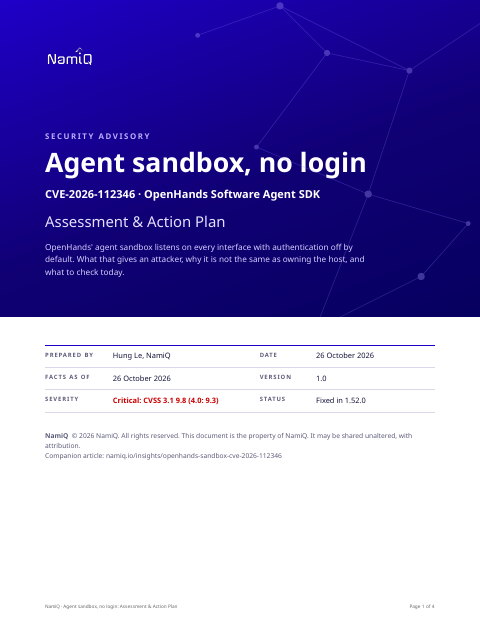 Free PDF · 4 pagesAgent sandbox, no login: Assessment & Action PlanThe full version as a PDF for whoever runs your agent infrastructure: the mechanism, severity decoded, exposure by deployment, our SOC analyst's assessment, a per-host procedure, hardening, hunting and a definition of done.Download the PDF →
What the bug is
The SDK starts an agent server inside a container so that an agent can run commands and edit files in a workspace. That server is meant to be controlled only by the process that launched it. Before 1.52.0 it listened on all interfaces, and an empty key list meant it accepted any caller. The published port is therefore a remote shell for whoever can reach it.
The weakness class is not exotic. It is the same shape as a database or a message broker left open with no password, and it is found the same way: by scanning for the port.
Root in the sandbox is not root on the host
Some summaries say the flaw gives code execution on the host that runs the SDK. The record says root inside the sandbox, with access to the mounted workspace and the secrets store. Those are different, and the difference decides your response.
What the attacker can do is bounded by what you put in the sandbox and what its network can reach. For many teams that is a source repository, cloud and model-provider tokens, and a route to internal services, which is already serious. Reaching the host is a further step, and it depends on how the container was started. A privileged container, or one with the Docker socket mounted into it, is a separate and much shorter path to the host. That is our reading of how containers work, not a statement in the advisory.
Our SOC analyst's assessment
- Treat it as same-day if the port is reachable from anywhere you do not control. The fix is a version bump, so the cost of acting now is small, and the cost of waiting rises if exploit code appears.
- Exposure depends on where the port is published, not on the version alone. A developer laptop on a home network, a shared development VM and a CI runner are three different answers.
- The first move when you cannot patch is to take the port off the network: bind it to 127.0.0.1 or a private address and close any load balancer, ingress or firewall rule that publishes it.
- Assume what the sandbox could see is exposed if the port was reachable. Rotate those secrets as a precaution. This is a judgement, not something the advisory asks for.
- Expect exploit code to follow within days to weeks. That is an estimate from how similar flaws have played out, not a fact about this one.
The agent's execution environment is part of the attack surface, even when the model itself is secure.
Step 1: find where it runs and what it exposes
# Agent containers and how their ports are published
docker ps --format '{{.Names}}\t{{.Image}}\t{{.Ports}}'
# Look for 0.0.0.0: mappings on agent containers

# Installed SDK version, from the interpreter that runs it
pip list 2>/dev/null | grep -i openhands

# Is anything listening beyond localhost?
ss -tlnp
Check the running environment, not the lockfile. Include CI runners, shared development hosts and any cloud instance that launches agent workspaces. Apptainer is common on research clusters, where a compromised node can reach shared storage, so count that blast radius too.
Step 2: upgrade and verify
- Upgrade to 1.52.0 or later through your normal pipeline, testing workspace launch and tool execution first.
- Set session API keys explicitly rather than relying on a default, and keep them out of the workspace.
- Publish the port on 127.0.0.1 or a private network only.
- Verify the running version after deployment, and confirm from another host that the port no longer answers.
Step 3: look for prior use
- Workspace or container launches you did not initiate, especially from addresses outside your own network.
- Shell processes inside agent containers that no task explains, and new files, cron entries or container images created outside normal working windows.
- Outbound connections from agent containers to hosts they do not normally use.
- If anything suspicious turns up, treat it as an incident and start from the secrets the sandbox could read.
Hardening that outlives the patch
- Run agent sandboxes unprivileged, without the Docker socket, on an isolated network with only the egress they need.
- Keep secrets out of the mounted workspace where you can, and scope the ones that must be there.
- Add authentication and network policy in front of the sandbox service even after the fix.
- Log workspace launches and shell execution inside agent containers so that an unexpected one is visible.
What we do not know yet
- Whether anyone has accessed an exposed instance. The record does not say.
- Whether public exploit code appears.
- How many instances are reachable from the internet.
If you take one thing from this: an agent's sandbox is a service with a port, a user and a set of secrets. Treat it like the other services you run, with a login, a network boundary and a log.