Someone asks whether it is done. You have an opinion, not an answer.
The release went out on Friday. Whether it was safe is something you will learn from a customer, from your error tracker, or not at all. The tests were green, which is the same thing they were the last time a screen was quietly broken for a week.
Every item of work here carries an agreed definition of done before it starts, so “finished” is a matter of evidence rather than opinion. Below is where that evidence comes from.
Four steps, running continuously
Understand
We read your problem — or your existing system — into a map of what it is, what depends on what, and where the gaps are. You get a plan you can challenge before anything is built.
Build
The work is split into small, tracked items with agreed acceptance criteria and assigned to the right specialist. Every change is isolated and reviewed.
Prove
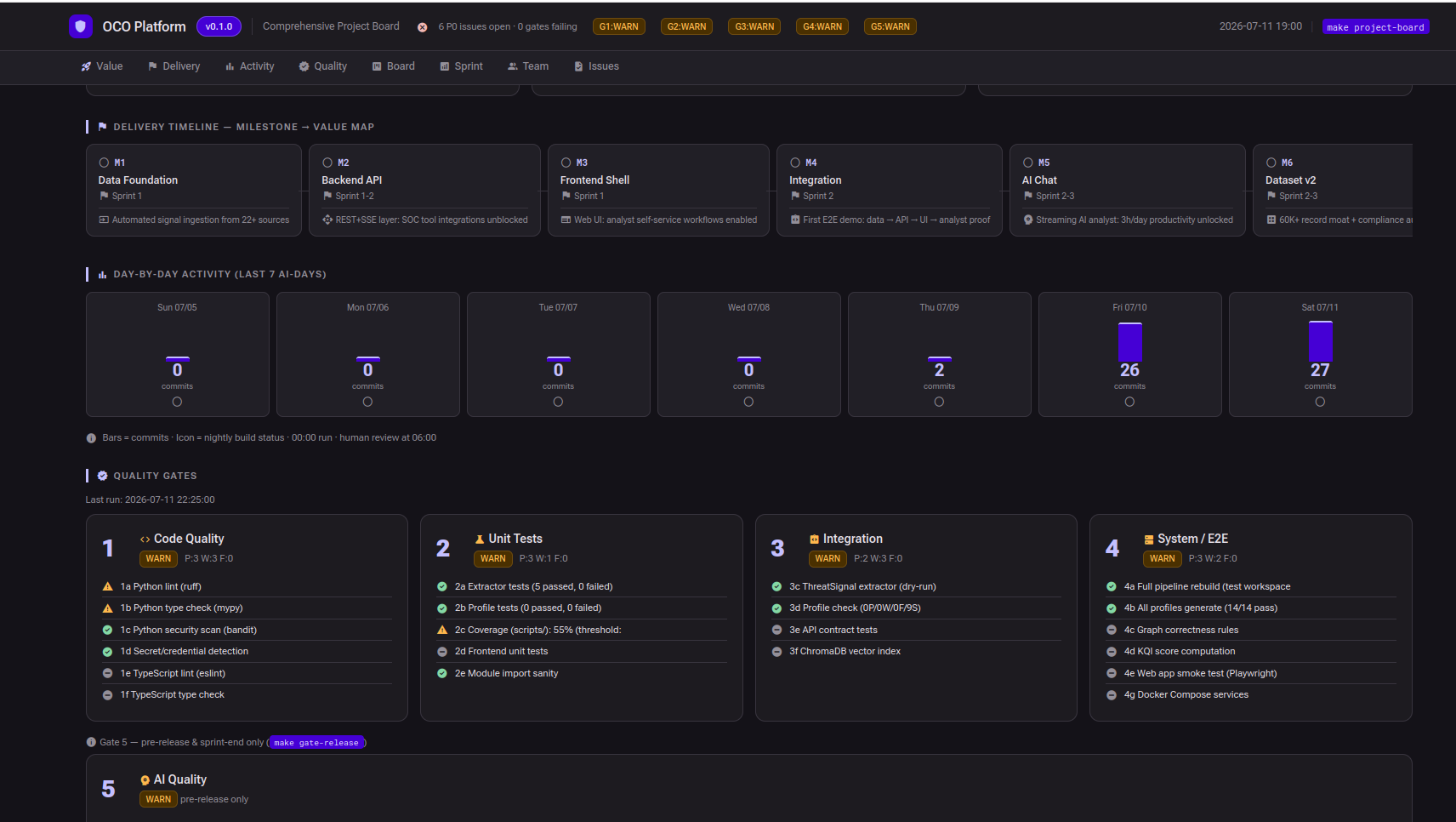
Six checks run before anything reaches your product — ending with whether a real person can finish the job on the running system.
Report
Progress, quality and cost are recorded as the work happens. One live board, always current. Blocked work shows the day it blocks.
Six checks. Nothing reaches you without passing them.
Each one is named and visible on the board while it runs — not a summary produced afterwards.
| # | Check | What it establishes | Runs |
|---|---|---|---|
| 01 | Security and code health | Insecure code, leaked credentials and unreadable work stopped at the door. | every change |
| 02 | Automated tests | Every change proved against the test suite — and the bar rises as your product grows. | every change |
| 03 | Integration | Confirms the parts still work together, not just on their own. | on integration |
| 04 | Whole system | Rebuilds everything from scratch and scans the full stack for vulnerabilities. | on integration |
| 05 | AI output quality | What the AI produced is sampled and scored. Nothing is assumed. | before release |
| 06 | Real user journey | Can a real person finish the job, end to end, on the running system. | before release |
The six checks stop broken work reaching you. They do not stop us being wrong the first time: 43% of our work was later redone, as at 2 August 2026. The gates catch it on our side of the line instead of yours, which is a smaller claim than never being wrong, and the only one the record supports.
Every test was green. The product was broken.
Two screens were failing to load, and only one of nine customer journeys could actually be completed — while every automated test reported success.
Tests can only check what someone thought to test. The one signal that cannot be faked is whether a person can finish the job.
The bar also rises with size. What was good enough at 5,000 lines is not enough at 165,000 — one live product as at 2 August 2026, not an average across a portfolio.
One operator. A full team of specialists.
Work is assigned to a role with a defined scope and a definition of done — never to a general-purpose prompt. That is why quality holds as the product grows.
One person is accountable
Sized to your project
Always the same bar
Everything, including the reasoning.
Working software
The evidence
The live board
A view of your running product
The decisions, written down
A map of your system
No lock-in
No customer data ends up in a delivered artifact, and a check enforces it.
Fixtures, demo records and examples use reserved addresses and invented names, so what you receive cannot carry a real customer row. The first of the six checks looks for credentials and real records in every change, before it is merged rather than at review time — a rule a person could break by forgetting is not a control.
What we do not claim here: we are not telling you the whole line runs inside your network, because we have no published evidence for that and you should not take it on assurance. Ask us on the call and you will get the specific answer for your setup.
Start with one piece of work.
Give us one piece of work and read access to one system. We map it and come back with what we found, what we would build and what it would take — before any commitment. You decide using our output, not our pitch.
Talk to us