The factory that builds the products.
An AI-operated factory — and laboratory — to make, enhance and maintain software. Not a tool. A process, with the machinery to run it: a sprint orchestrator, a live board, and six checks that decide what ships.
Position as at 2 August 2026 on a live product. Full results →
Three pieces. You can point at all of them.
Not a methodology and not a prompt library. Each piece is a running program with a screen you can open, and the screenshots below are that screen on our own product this week.
1 · The orchestrator
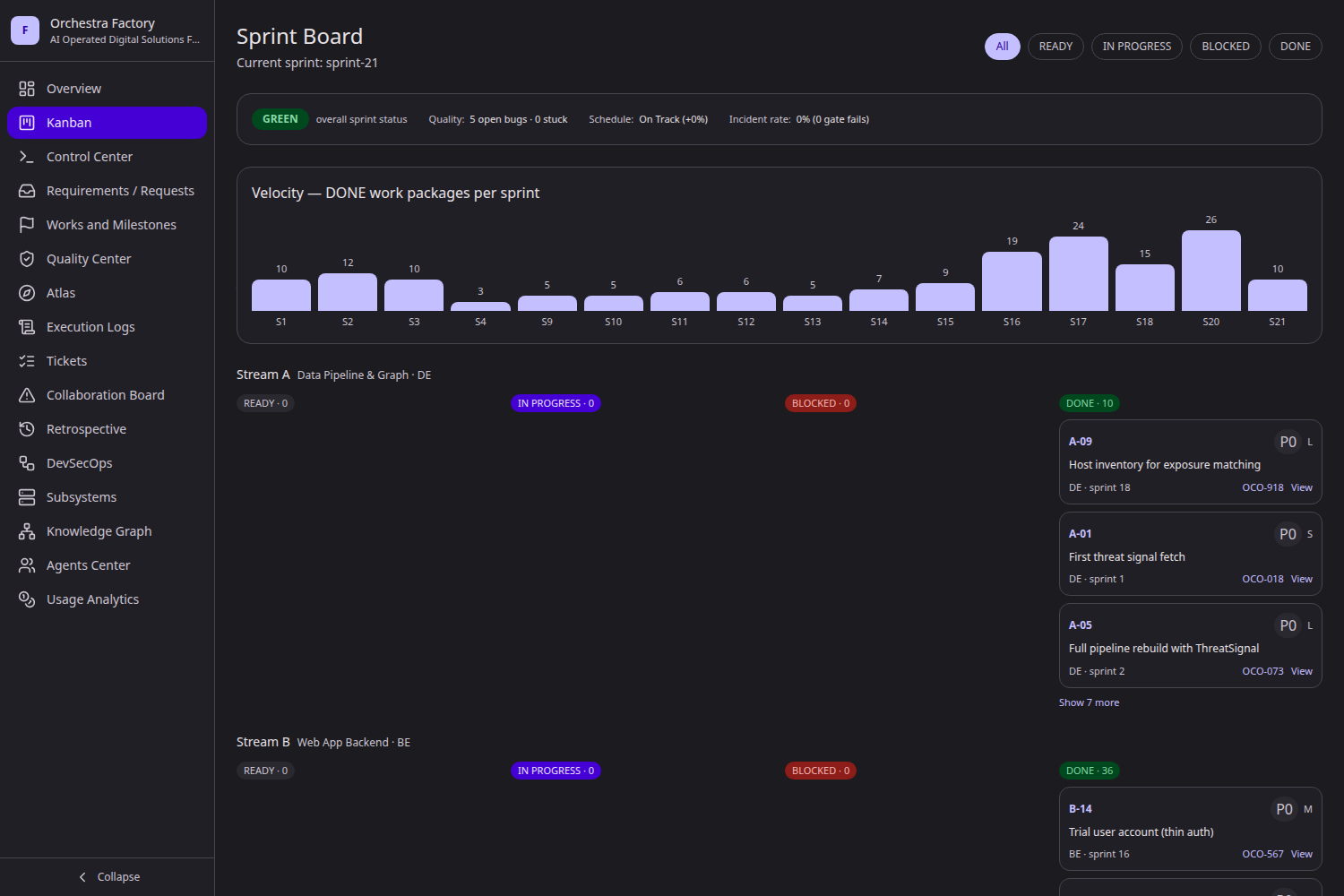
2 · The board
3 · Six quality gates
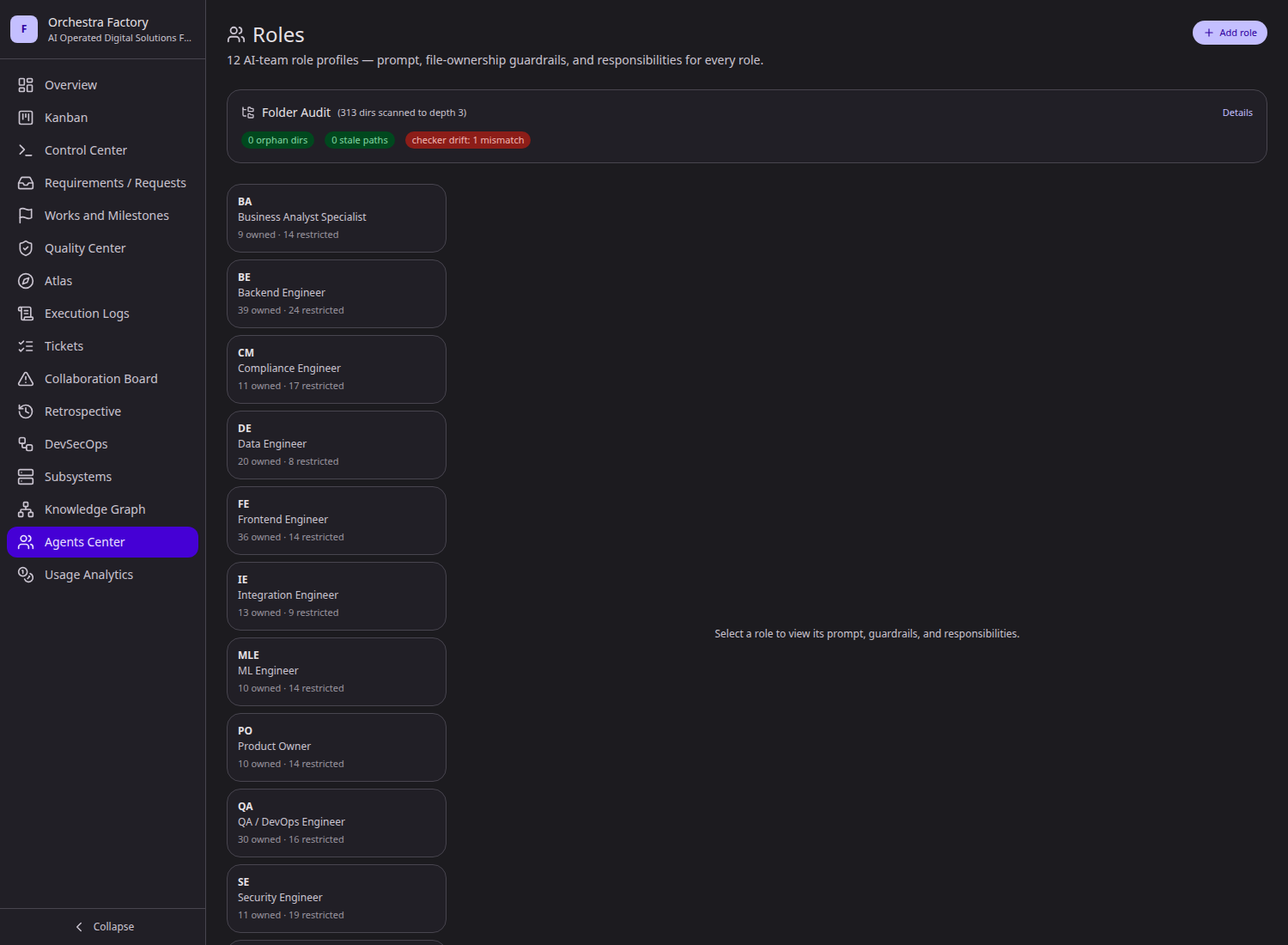
Twelve specialist roles, and each one is fenced in.
“Twelve roles” on its own is an org chart anyone can type. What makes it real is the second and third columns below: each role owns a set of paths it may write, and a set it must not touch. The Backend Engineer cannot edit the frontend. The Compliance Engineer cannot edit either.
That is the mechanism behind the claim that quality holds as a product grows. One general-purpose agent with write access everywhere degrades as the codebase passes the size a single context can hold — it starts changing things it has not read. A role that cannot reach a directory cannot break it at 3am.
| Role | OwnsPaths it owns | Off-limitsPaths it may not touch |
|---|---|---|
| TLTechnical Lead | 18 | — |
| POProduct Owner | 10 | 14 |
| BABusiness Analyst | 9 | 14 |
| BEBackend Engineer | 39 | 24 |
| FEFrontend Engineer | 36 | 14 |
| DEData Engineer | 20 | 8 |
| MLEML Engineer | 10 | 14 |
| QAQA / DevOps Engineer | 30 | 16 |
| SESecurity Engineer | 11 | 19 |
| CMCompliance Engineer | 11 | 17 |
| IEIntegration Engineer | 13 | 9 |
| UXUI/UX Designer | 21 | 18 |
The Technical Lead has no restricted paths, which is deliberate: it is the role that reviews across boundaries, and it is also the one an escalation reaches. Counts as at 5 September 2026, read from the board.
Agents do the work. Gates decide what ships.
The hard part of running AI agents on real software is not getting them to write code. It is knowing which of their output is safe to keep.
ODSF answers that with checks that run on every change and block on failure, and with a process where being blocked is loud, idleness is visible, and metrics are recomputed rather than reported. The factory is designed to be honest about its own state, because a factory that is optimistic about itself produces confident nonsense at scale.
It is installed into a project by symlink rather than copied per project, so improving the factory improves every product built on it at once — and a fix is never pending in three places.
It runs on itself.
The factory is built on its own line and passes its own checks. If it did not work, this is what would break first — which is a more demanding test than any case study.
A cybersecurity platform
An education platform
A system you already have
See it work on a system of yours.
Every NamiQ engagement runs on this factory, operated by our team. Start by having one system mapped at no charge. The write-up is yours either way, and so is everything the factory produces after it.
Talk to us