The one document every company that runs IT should read each month.
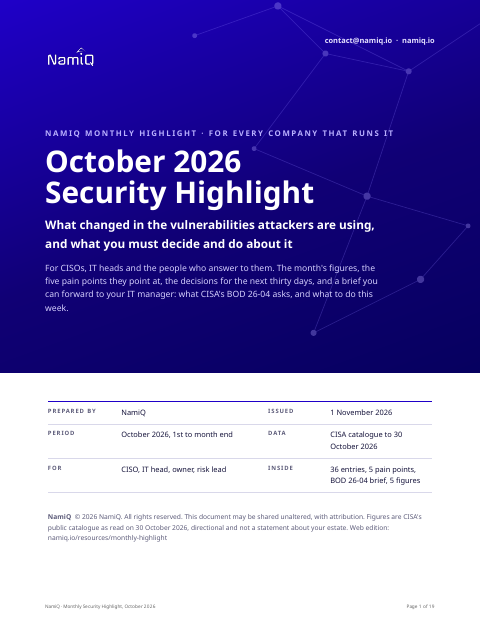
What changed in the vulnerabilities attackers are using, and what you must decide and do about it: the month’s figures from CISA’s exploited list, the five pain points they point at, the decisions for the next thirty days with an owner and a date, and a brief you can forward to your IT manager on what CISA’s BOD 26-04 asks.
Free to read, no email needed. Every figure is dated and every rule is printed in the document.
Ask your AI agent about a new vulnerability with sources attached: Lattice. See Lattice
The month on a page
October 2026 added 36 flaws to CISA's list, 7 fewer than September's 43, but the due dates stayed short: the median is 3 days against 14 over the last twelve months, and 29 of the 36 are due within 7 days. Plan for a patch window of days, not weeks. First decision: name who can approve an emergency change on internet-facing systems.
Our reading of the figures below, not a statement by CISA.
- Added to CISA's list
- 36
- September 2026: 43 (-16.3%). October 2025: 31 (+16.1%).
- Median window to fix
- 3 days
- The twelve months before: 14 days. 29 of 36 gave 7 days or fewer.
- Ransomware use recorded
- 0 of 36
- 10.4% over the twelve months before. “Not recorded” is not “none”.
- Network edge and remote access
- 16.7%
- 6 of 36. The twelve months before: 11.7%.
- Older than three years
- 13.9%
- 5 of 36. The twelve months before: 16.9%.
- Entries that name a chain
- 12 of 36
- CISA's description says the flaw can be chained with another.
Decisions for the next thirty days
Our reading: each one rests on a figure above.
- 1 · IT head · this weekName who can approve an emergency change to internet-facing systems, including out of hours
The median due date is 3 days and 29 of 36 October entries are due within 7 days, so approval cannot wait for a normal change cycle.
- 2 · IT provider · this weekList where you run Ivanti Connect Secure, PHP, AhsayCBS, Zammad or Plex Media Server, and patch all linked flaws together
12 of 36 entries name a chain, across 6 chains. Each of these products appears in one of them.
- 3 · IT provider · this weekUpdate PHP and the Linux kernel together on any server that runs PHP
CISA says CVE-2026-46300 can be chained with the two PHP flaws to plant a webshell and run commands as root. All three carry 3-day deadlines.
- 4 · security lead · within 30 daysPut internet-facing devices at the front of the patch queue
Edge products are 6 of 36 entries (16.7%), against 11.7% over twelve months.
- 5 · CISO · within 30 daysFind and retire or patch software that predates last year
5 of 36 entries are older than last year, the oldest being CVE-2015-3306. Old software still gets added to CISA's list.
Your five pain points this month
What a security leader loses sleep over, what this month’s figures say about each, what to do, and the proof to keep. The wording is ours, written from the figures; the figures are CISA’s.
- 1. We cannot fix things in days.
- The figures
- October 2026: 36 entries, a median of 3 days from CISA adding an entry to its due date, against 14 over the twelve months before. 29 of 36 gave 7 days or fewer. For a federal agency, CISA's rule (BOD 26-04, Table 1) is 3 days, with a check for compromise, when an exposed system carries a listed flaw that an attacker can automate and that gives total control.
- Do
- Name the person who can approve an emergency change and write down the route. Then take the last entry that applied to you and time it from the day it was listed to the day it was fixed.
- Keep
- The dated record: listed on, fixed on, version, who approved.
- 2. We do not know what we run.
- The figures
- A list of 36 new entries a month cannot be matched to systems nobody has counted. BOD 26-04 asks agencies to identify and tag every asset reachable from outside, with its environment, its exposure (public or internal) and its type (server, application or network device).
- Do
- One line per system: what it is, the version, who owns it, whether it is reachable from the internet, production or not. Start with what faces the internet.
- Keep
- The list, with the date it was last reviewed.
- 3. What faces the internet is what gets hit first.
- The figures
- 6 of 36 entries (16.7%) were in network-edge and remote-access products, against 11.7% over the twelve months before. CISA's own text for BOD 26-04 counts removing a system from the internet as a valid mitigation, because that changes the timeline that applies to it.
- Do
- List every firewall, VPN, gateway, router and remote-access product you run. Ask of each: does it need to face the internet, and who patches it?
- Keep
- The list of internet-facing products, with versions and the date each was last updated.
- 4. Old software nobody remembers.
- The figures
- 5 of 36 entries (13.9%) named a CVE from three or more years earlier; the oldest was CVE-2015-3306. The twelve months before: 16.9%. An old flaw on the list means an unpatched or unsupported system somewhere.
- Do
- Find what is past end of support or has not been updated in a year. Retire it, replace it, or take it off the network, and write down which.
- Keep
- The decision for each old system, with a date.
- 5. We cannot show an auditor, an insurer or a customer that we acted.
- The figures
- Questionnaires, audits and cyber-insurance forms ask what you run, how fast you fix, and what proof you hold. The answer that survives is a dated record, not a statement. BOD 26-04 itself asks agencies for internal tracking and reporting, and for a written forensic triage report on the fastest cases.
- Do
- For each entry that applied to you this month, write one line: listed on, fixed on, version fixed in, proof (a command's output or a screenshot, with the date).
- Keep
- A single monthly record, kept where an auditor can be given it.
For your IT manager: what CISA’s BOD 26-04 asks, and what to do this week
This section is the part of the document to forward. CISA’s own pages, read 1 November 2026.
BOD 26-04 is a directive CISA issued on 10 June 2026 to federal civilian agencies. It binds them, not a private company; it is the best public benchmark there is for how fast an exploited flaw should be dealt with.
It replaced two earlier directives, BOD 22-01 (which created the exploited list) and BOD 19-02. CISA sets the fix time by four questions: is the asset publicly exposed, is the flaw on the exploited list, can an attacker automate every step, and how much control does exploitation give.
CISA publishes the answers to the second, third and fourth for each CVE; you answer the first for your own systems.
CISA’s Table 1: how fast, by four questions
| # | Publicly exposed? | On CISA’s list? | Attacker can automate? | Technical impact | Timeline |
|---|---|---|---|---|---|
| 1 | Yes | Yes | Yes | Total control | 3 days & forensic triage |
| 2 | Yes | Yes | Yes | Partial control | 3 days |
| 3 | Yes | Yes | No | Total control | 3 days & forensic triage |
| 4 | Yes | Yes | No | Partial control | 14 days |
| 5 | Yes | No | Yes | Total control | 3 days |
| 6 | Yes | No | Yes | Partial control | 14 days |
| 7 | Yes | No | No | Total control | 14 days |
| 8 | Yes | No | No | Partial control | 60 days |
| 9 | No | Yes | Yes | Total control | 3 days & forensic triage |
| 10 | No | Yes | Yes | Partial control | 14 days |
| 11 | No | Yes | No | Total control | 14 days |
| 12 | No | Yes | No | Partial control | 14 days |
| 13 | No | No | Yes | Total control | 60 days |
| 14 | No | No | Yes | Partial control | 60 days |
| 15 | No | No | No | Total control | Fix on system upgrade |
| 16 | No | No | No | Partial control | Fix on system upgrade |
Days are calendar days. “& forensic triage” means the fix or mitigation and a check for compromise, both inside the timeline. Removing a system from the internet changes “publicly exposed” and so the timeline that applies. Read the directive.
This week, in order
- List what faces the internet: product, version, owner, production or not. CISA defines 'publicly exposed' as reachable by unauthenticated or untrusted parties over a public network.
- Compare that list with Appendix A, and with the weekly and daily lists linked in this document. Mark every match.
- For each match, find its row in Table 1 and write the timeline next to it. If the row says forensic triage, collect evidence before you patch (steps 1 and 2).
- Fix or mitigate within that timeline, or take the system off the internet and write down that you did. Keep the version output or a screenshot, with the date.
- Sign up for CISA's email alerts for new entries, and name who reads them. The sign-up is on CISA's directive page.
- At the end of the week, write the month's record: entries that applied, listed on, fixed on, proof. File it where an auditor can be given it.
If a row says forensic triage: CISA’s six steps
From CISA’s implementation guidance. The timelines are CISA’s recommended practice, not a requirement; the requirement is that an adequate triage is done. Counted from the day the entry is added.
- 1. Scope (within 2 hours). Work out which systems and services are in scope. Set up a way to talk that does not depend on systems that may be compromised.
- 2. Preserve and collect evidence (2 to 24 hours). Capture volatile data (memory, connections) first, and do not alter or fix the system before collecting when you can avoid it. Keep a log of what was collected, from where, when and by whom.
- 3. Patch and stabilise (2 to 24 hours). After the evidence is collected, apply the critical patch, and keep the business systems that depend on it working.
- 4. Contain and control (6 to 24 hours). Isolate affected and suspect systems, coordinated with evidence collection and patching. Contain in a way that does not tell an intruder they have been seen.
- 5. Analyse (24 to 48 hours). Look for unauthorised access, an intruder's presence, movement to other systems, persistence, and data staged or taken. Check whether the indicators exist elsewhere.
- 6. Decide on escalation (48 to 72 hours). Write the timeline and findings (who, what, where, when) and decide: no evidence of compromise, suspected, or confirmed, and who to tell.
Keep it current: the week and the day
The month is one document; the week and the day are where the next entry shows up first. Each page links to our note and analysis report for every CVE it names.
- Weekly highlight and guideline, 1 November 2026: 10 exploited CVEs, 6 new critical records, and your week in order
- Daily threat watch, 31 October 2026: 10 exploited CVEs added this week, 6 to act on now
- Daily threat watch, 30 October 2026: 10 exploited CVEs added this week, 6 to act on now
- Daily threat watch, 29 October 2026: eight exploited CVEs in seven days, five that need action today
- Daily CVE highlight, 31 October 2026: 3 new critical CVEs worth reading
- Daily CVE highlight, 30 October 2026: 3 new critical CVEs worth reading
- Daily CVE highlight, 28 October 2026: four 9.8s, and each one turns on a different question
- Today’s mission: every exploited vulnerability from the last seven days, in the order their deadlines fall
- All the weekly highlights and guidelines
Every entry added in October 2026 (36), with our note where we have one
| Added | CVE | Product | Days | Our page |
|---|---|---|---|---|
| 1 October | CVE-2026-104286 | Fortinet FortiMail | 3 | CVE record |
| 2 October | CVE-2026-102489 | Zammad GmbH Zammad | 3 | CVE record |
| 2 October | CVE-2026-102490 | Zammad GmbH Zammad | 3 | CVE record |
| 4 October | CVE-2026-88779 | Citrix NetScaler | 3 | CVE record |
| 8 October | CVE-2015-3306 | ProFTPD ProFTPD | 3 | CVE record |
| 8 October | CVE-2015-5477 | ISC BIND | 3 | CVE record |
| 8 October | CVE-2016-3081 | Apache Struts | 3 | CVE record |
| 8 October | CVE-2021-3199 | ONLYOFFICE Docs | 3 | CVE record |
| 8 October | CVE-2023-22894 | Strapi Strapi | 3 | CVE record |
| 13 October | CVE-2026-104935 | Ivanti Connect Secure | 3 | CVE record |
| 13 October | CVE-2026-96951 | Microsoft Windows | 3 | CVE record |
| 14 October | CVE-2026-0322 | Palo Alto Networks PAN-OS | 3 | CVE record |
| 14 October | CVE-2026-105133 | Ahsay AhsayCBS | 3 | CVE record |
| 14 October | CVE-2026-105134 | Ahsay AhsayCBS | 3 | CVE record |
| 14 October | CVE-2026-76519 | Cisco Secure Email Gateway | 3 | CVE record |
| 15 October | CVE-2026-21589 | Atlassian Multiple Products | 3 | CVE record |
| 16 October | CVE-2025-61624 | Fortinet Multiple Products | 3 | CVE record |
| 16 October | CVE-2026-102764 | BeyondTrust Remote Support | 3 | CVE record |
| 20 October | CVE-2026-106931 | EG Secure Solutions SiteGuard Server Edition | 3 | CVE record |
| 20 October | CVE-2026-110936 | Siemens Software Center | 14 | CVE record |
| 20 October | CVE-2026-96652 | Plex Media Server | 14 | CVE record |
| 20 October | CVE-2026-96654 | Plex Media Server | 3 | CVE record |
| 20 October | CVE-2026-96655 | Plex Media Server | 14 | CVE record |
| 20 October | CVE-2026-96656 | Plex Media Server | 3 | CVE record |
| 23 October | CVE-2026-110447 | Collabora Collabora Online – Built-in CODE Server | 3 | Note · Report |
| 23 October | CVE-2026-114625 | Arista VeloCloud Orchestrator | 3 | Note · Report |
| 26 October | CVE-2026-109618 | PHP Group PHP | 3 | Note · Report |
| 26 October | CVE-2026-109619 | PHP Group PHP | 3 | Note · Report |
| 27 October | CVE-2026-111497 | Google Brotli | 14 | Note · Report |
| 27 October | CVE-2026-48356 | Adobe Commerce and Magento | 14 | Note · Report |
| 28 October | CVE-2026-41709 | Broadcom VMware ESX | 14 | Note · Report |
| 28 October | CVE-2026-46300 | Linux Kernel | 3 | Note · Report |
| 29 October | CVE-2026-76418 | Cisco Secure Firewall ASA Software and Cisco Secure FTD Software | 3 | Note · Report |
| 29 October | CVE-2026-97229 | GitLab Community Edition and Enterprise Edition | 3 | Note · Report |
| 30 October | CVE-2026-111357 | Ivanti Connect Secure | 3 | Note · Report |
| 30 October | CVE-2026-118527 | Ivanti Connect Secure | 14 | Note · Report |
The two charts that carry the month
Entries added to CISA’s list, by month
Median days CISA gives to fix an entry
Vendors with the most entries in October 2026
- Plex4 entries
- Ivanti3 entries
- Ahsay2 entries
- Cisco2 entries
- Fortinet2 entries
- PHP Group2 entries
Weakness classes, share of entries
- Memory safety13.9%before 14%
- Injection and unsafe input19.4%before 25%
- Authentication and access control16.7%before 25%
- Files, paths and uploads16.7%before 7%
- Request forgery and redirection5.6%before 4%
- Other weaknesses27.8%before 21%
- No weakness recorded0%before 4%
Chains: an exploit trend
12 of 36 entries added in October 2026 (33.3%) say in CISA’s description that the flaw can be chained with another, against 2.3% over the twelve months before. A chain means fixing one flaw of the set is not the end of the work: the entry flaw gets an attacker in, and the next one gives them more.
Entries naming a chain were 1 in December 2025, 2 in July 2026, 3 in August and 1 in September. Other months had none. October had 12 of 36 (33.3%, against 2.3% over twelve months), forming 6 chains: Plex, Ivanti, Zammad, Ahsay, PHP with the Linux kernel, and Strapi. The count reflects how CISA words its entries and may not equal what attackers do.
The chains of October 2026
- Plex Media Server · 4 entries, one product
This vulnerability can be chained with CVE-2026-96652, CVE-2026-96654, and CVE-2026-96655.
Our reading. All four are Plex Media Server flaws added on 20 October 2026. CISA describes two server-side request forgeries, a way to call other plugins' functions, and an admin file write where files may run on load. Fix all four. Start with CVE-2026-96654 and CVE-2026-96656, which have the 3-day deadlines. No fixed version is in our record.
- Ivanti Connect Secure · 3 entries, one product
This vulnerability can be chained with CVE-2026-104935 and CVE-2026-111357.
Our reading. Three Ivanti Connect Secure flaws. CVE-2026-104935 lets a remote unauthenticated attacker run commands, per CISA. CVE-2026-118527 lets an authenticated attacker upload files to a known location. CVE-2026-111357 is a local privilege escalation. Fix the entry point CVE-2026-104935 first, then the other two.
- PHP Group PHP + Linux Kernel · 3 entries, across products
This vulnerability can be chained with CVE-2026-109618 and CVE-2026-109619 to implant PHP webshells and run commands as root.
Our reading. Two PHP flaws, CVE-2026-109618 and CVE-2026-109619, each allow unauthenticated remote code execution, per CISA. CVE-2026-46300 is a Linux kernel flaw. CISA says the three can be chained to implant PHP webshells and run commands as root. Fix PHP first, then the kernel.
- Zammad GmbH Zammad · 2 entries, one product
This vulnerability can be chained with CVE-2026-102489.
Our reading. Zammad, two flaws. CVE-2026-102489, a session fixation, can lead to remote code execution as the zammad user. CVE-2026-102490 lets that local user escalate to root. Together they run from entry to root on the Zammad server. Fix CVE-2026-102489 first, then CVE-2026-102490. Both were added on 2 October 2026.
- Ahsay AhsayCBS · 2 entries, one product
This vulnerability can be chained with CVE-2026-105133.
Our reading. Ahsay AhsayCBS, two flaws added on 14 October 2026. CVE-2026-105133 is an authentication bypass. CVE-2026-105134 is a command injection that lets a remote attacker run operating system commands. CISA says they can be chained. Fix both together. No fixed version is in our record.
- Strapi Strapi · 1 entry, one product
This vulnerability can be chained with CVE-2023-22621 to achieve remote code execution.
Our reading. One Strapi entry. CISA says CVE-2023-22894 lets someone with admin panel access discover sensitive user details, and can be chained with CVE-2023-22621 for remote code execution. CVE-2023-22621 is not on this month's list. CISA warns the product may be end-of-life. Check who can reach the admin panel first.
A sample attack path: Ivanti Connect Secure
- EntryCVE-2026-104935
Ivanti Connect Secure contains an authentication bypass by spoofing vulnerability that allows a remote unauthenticated attacker to execute arbitrary commands.
- Middle stepCVE-2026-118527
Ivanti Connect Secure contains a generation of predictable numbers or identifiers vulnerability that allows a remote authenticated attacker to upload files with attacker-controlled content to a known location on disk. This vulnerability can be chained with …
- EscalationCVE-2026-111357
Ivanti Connect Secure contains a missing authentication for critical function vulnerability that could allow a local authenticated attacker to escalate their privileges. This vulnerability can be chained with CVE-2026-104935 and CVE-2026-118527.
- What CISA says it gives
CISA names these entries as one chain and does not say what it achieves.
A sample attack path: PHP Group PHP + Linux Kernel
- EntryCVE-2026-109618
PHP contains an out-of-memory corruption vulnerability that allows for unauthenticated remote code execution.
- EntryCVE-2026-109619
PHP contains a stale internal request-state vulnerability that allows for unauthenticated remote code execution.
- EscalationCVE-2026-46300
Linux Kernel contains a missing initialization of a variable vulnerability that could allow for unintended modification of page-cache-backed data via failure to preserve the shared-fragment marker during socket buffer coalescing, causing ESP input processing …
- What CISA says it gives
implant PHP webshells and run commands as root
The five entries to know this month
Chosen by a printed rule: EPSS 0.90 or more 4 points, 0.50 or more 3, 0.10 or more 2, otherwise 0; named in a chain by CISA 3; network edge or remote access 2; ransomware use known 1. One entry per product; ties go to the higher EPSS, then the lower CVE number. EPSS is FIRST’s estimate of the chance of exploitation in the next 30 days, as scored on 31 October 2026.
- 1. Ivanti Connect Secure CVE-2026-1049358 points · EPSS 0.868 · chain · edge
Ivanti Connect Secure contains an authentication bypass by spoofing vulnerability that allows a remote unauthenticated attacker to execute arbitrary commands.
Our reading. Ivanti Connect Secure authentication bypass by spoofing, which CISA says lets a remote unauthenticated attacker run commands. It ranks first with 8 points: 3 for EPSS, 3 for being in a chain, 2 for being an edge product. Anyone running Connect Secure looks first. It sits in a chain with CVE-2026-118527 and CVE-2026-111357. We have no note on it, and no fixed version is in our record.
- 2. PHP Group PHP CVE-2026-1096187 points · EPSS 1.000 · chain
PHP contains an out-of-memory corruption vulnerability that allows for unauthenticated remote code execution.
Our reading. A PHP out-of-memory corruption flaw that CISA says allows unauthenticated remote code execution. It ranks second with 7 points: 4 for EPSS, 3 for being in a chain. Anyone running PHP on a public site looks first. CVE-2026-109619 was added the same day. Our note covers which versions fix them, how to check a server without being fooled by your package manager, and what to do if you cannot patch today.
- 3. Ahsay AhsayCBS CVE-2026-1051346 points · EPSS 0.818 · chain
Ahsay AhsayCBS contains a command injection vulnerability that could allow a remote attacker to execute operating system commands via manipulation of the random parameter in the Replication Receiver component’s /rps/api/json/UpdateReceivers.do endpoint. This vulnerability can be chained with CVE-2026-105133.
Our reading. An AhsayCBS command injection that CISA says lets a remote attacker run operating system commands. It ranks third with 6 points: 3 for EPSS, 3 for being in a chain. CISA says it can be chained with the authentication bypass CVE-2026-105133. Anyone running AhsayCBS looks first and patches both. We have no note on it, and no fixed version is in our record.
- 4. Zammad GmbH Zammad CVE-2026-1024895 points · EPSS 0.225 · chain
Zammad GmbH Zammad contains a session fixation vulnerability that can lead to remote code execution as the zammad user. This vulnerability can be chained with CVE-2026-102490.
Our reading. A Zammad session fixation that CISA says can lead to remote code execution as the zammad user. It ranks fourth with 5 points: 2 for EPSS, 3 for being in a chain. CISA says it chains with CVE-2026-102490, a privilege escalation to root. Anyone running Zammad looks first and fixes both. We have no note on it, and no fixed version is in our record.
- 5. Linux Kernel CVE-2026-463005 points · EPSS 0.161 · chain
Linux Kernel contains a missing initialization of a variable vulnerability that could allow for unintended modification of page-cache-backed data via failure to preserve the shared-fragment marker during socket buffer coalescing, causing ESP input processing to decrypt shared fragments in place. This vulnerability can …
Our reading. A Linux kernel local privilege escalation. Our note says it dates from May, scores 7.8 and was added on 28 October 2026. It ranks fifth with 5 points: 2 for EPSS, 3 for being in a chain. CISA says it chains with the two PHP flaws to plant a webshell and run commands as root. Anyone running PHP on Linux looks first. Patch the kernel and PHP together; our note gives the order.
What is in each issue
Written for a security leader who has ten minutes before a meeting and an auditor who has the document open next to it.
- 1The month on a page
The bottom line, six figures with their comparisons, and the decisions for the next thirty days, each with an owner and a date.
- 2Your five pain points
The five things a security leader loses sleep over, what the month's figures say about each, what to do, and the proof to keep.
- 3For your IT manager
What CISA's BOD 26-04 asks, its Table 1 of fix times, a checklist for the week, and the six forensic triage steps, written to forward.
- 4What changed
Twelve months of additions to CISA's exploited list, set against last month, the same month a year ago and the average.
- 5The patching clock
How long CISA gives to fix an entry, month by month, and what changed in the wording of its required action.
- 6Where the pressure was
Which vendors, which product families and which weaknesses, how old the flaws are, and the exploit trend: the chains CISA names, with a sample attack path.
- 7The five entries to know
The month's five entries by a printed rule, each with what it is, why it ranks, who looks first and where to read more.
- 8For your next leadership meeting
Questions to put to your IT team or provider, what to watch next month, and what the figures cannot tell you.
- 9Appendices
Every entry for the month, and the method: each rule, definition and limit, so you can disagree with a rule instead of trusting a label.
Issues
- October 202636 entries · median window 3 days · issued 1 November 2026Download · 19 pages
Hear when the next issue is out
One note a month, once the issue is published. One click to unsubscribe. We do not sell or share the list, and we contact a company at most once every 30 days; that limit is built into our system.
We keep your name, work email, company and role. Nothing else. Privacy · Unsubscribe or delete
Questions
- Where do the figures come from?
- One public source: CISA's Known Exploited Vulnerabilities catalogue, counted by the date CISA added each entry. Every grouping is a fixed rule that the document prints.
- Is it a judgement about my estate?
- No. It says what changed in the list, not whether you are affected. A month with fewer entries is not a safer month for a firm that runs the products on them.
- Who writes the commentary?
- The sections headed Our reading are our interpretation of the figures. Each sentence is checked by code against those figures, and the document says so.
- Do you hold SOC 2, or certify anyone?
- No. NamiQ does not hold SOC 2 and issues no attestations. This is a reading of public data.
- Can I share it?
- Unaltered, with attribution. The cover says so.
Start with one piece of work.
Give us one piece of work and read access to one system. We map it and come back with what we found, what we would build and what it would take — before any commitment. You decide using our output, not our pitch.
Talk to us