Juniper Session Smart Router CVE-2026-103409: a 9.8 that is only open until the device is onboarded
Most critical flaws are reachable all the time. This one, in Juniper Networks Session Smart Router, has a condition attached that the severity score cannot show: Juniper says it can only be exploited before the device is onboarded to Mist or Conductor, and cannot be once it is. That turns a question about the product into a question about the device, and specifically about what state each of yours is in when it first meets a network.
This note is for you if you run Session Smart Routers, or manage them for others. Everything is as of 28 October 2026 and every claim links to its source at the end.
The short version
- CVE-2026-103409 (CWE-306, missing authentication for a critical function): an unauthenticated network attacker can obtain administrative privileges by passing crafted URL parameters to an insecure endpoint that runs as root. CVSS 3.1 9.8.
- Condition: it can only be exploited before the device is onboarded to Mist or Conductor. Once onboarded, it can no longer be exploited.
- Affected: Session Smart Router before 7.0.5, from 7.1.0 before 7.1.7, and from 7.2.0 before 7.2.3.
- Fixed: 7.0.5, 7.1.7 and 7.2.3, and all later releases.
- Juniper lists no workaround. Its security team says it is not aware of any malicious exploitation.
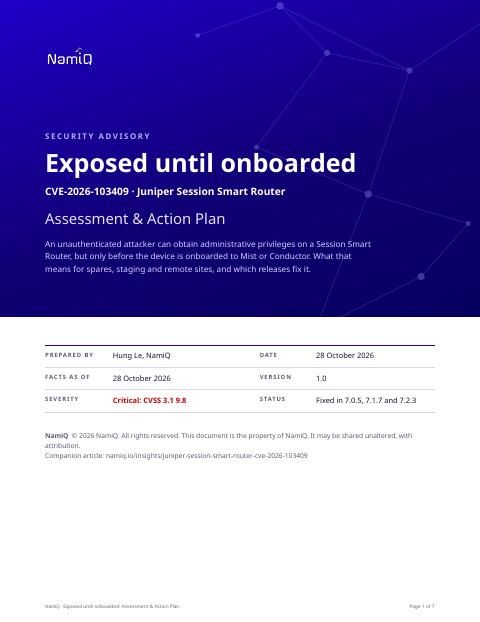 Free PDF · 7 pagesExposed until onboarded: Assessment & Action PlanThe full version as a PDF for whoever runs your branch and WAN routers: the mechanism as Juniper describes it, severity decoded, the fixed release per line, exposure by device state, a staging and onboarding procedure, hunting and a definition of done.Download the PDF →
What the bug is
An endpoint on the device accepts a request and, from the URL parameters alone, hands back administrative privileges. It runs as root and it does not check who is asking. That is the whole defect: a function that should require proof of identity does not. Because the endpoint is available only until the device is onboarded, it looks like part of the device's first-contact behaviour, the window when a new router has not yet been told who manages it. Juniper does not describe the endpoint further, and neither will we.
What "onboarded" means
Juniper's documentation describes two routes. A device can be adopted into a Mist organisation: it connects to the Mist cloud, is claimed into the organisation's inventory and is assigned to a site. Or, for a Conductor-managed device, the Conductor must already hold a configuration for the router before it powers up, and the asset ID must match; the Conductor's address is normally set on the Mist site that adopts it. Newer releases (7.1.3 and later) add a secure onboarding flow that uses the device's TPM.
So the unsafe period is the time between a router being switched on and reachable, and that handshake completing. For a router that arrives, is connected at a branch and is adopted within minutes, the window is short. For one that sits in a depot, is staged on a bench, is returned and reset, or is installed at a remote site before anyone completes adoption, it can last days or weeks.
Who is exposed
Not "everyone running a Session Smart Router". Exposure is the set of devices that are, right now, reachable by an attacker and not yet onboarded:
- New devices connected to a network before adoption is complete.
- Spares and replacements powered up for testing.
- Devices that were factory-reset and are waiting to be re-onboarded.
- Lab and demonstration units on shared networks.
A router that is onboarded and running in production is not exposed to this flaw. That does not make it safe to ignore: running an affected release is a risk the next time you need to re-onboard it.
Things people will get wrong
- "Every affected release is exploitable." Only before onboarding.
- "There is a workaround." Juniper says there are none. Isolating the device until it is onboarded is risk reduction, not a vendor mitigation.
- "It is being exploited." Juniper's security team says it is not aware of malicious exploitation. That is a point-in-time statement.
How we would triage it
This is our judgement from the conditions in the record.
- Start with the state, not the version. List every router with its onboarding status. The ones that are not onboarded are your emergency list.
- Get fixed software onto a device before it touches a network you do not control. Stage on an isolated network, upgrade to a fixed release, and only then connect it.
- For the onboarded fleet, upgrade in your normal cycle, but do not leave it so long that a re-onboard in six months starts from a vulnerable build.
Step 1: find every router and its state
Use your inventory, Mist and any Conductor to list each Session Smart Router with its software release and whether it has been adopted or onboarded. Then add the ones the inventory does not know about: spares in cupboards, units at remote sites that were installed by someone else, and anything bought through a reseller and shipped straight to a branch.
Step 2: take unonboarded devices off exposed networks
- Do not connect a device to an internet-facing or user network until it is onboarded.
- Complete adoption on an isolated management network, then move it.
- For remote sites, agree who completes onboarding and when, so that a router is not left powered up and waiting.
Step 3: upgrade
- Move to 7.0.5, 7.1.7 or 7.2.3 or later, following Juniper's upgrade guidance for your line.
- Put the fixed release on spares and staged devices before they are deployed, so that the next device does not start vulnerable.
Step 4: look backwards
- For any device that sat unonboarded on a reachable network, check its configuration against what you intended: administrator accounts, authentication settings, management addresses.
- Look at network logs for connections to the device's management interface from unexpected addresses during the period it was unonboarded.
- If a device shows an account or setting nobody can explain, treat it as compromised: rebuild it rather than clean it.
What we do not know yet
- The vulnerable endpoint and parameters. Juniper does not publish them.
- Whether anyone is exploiting it. Juniper says it is not aware of any.
- Whether other Juniper products share the endpoint. The advisory names only Session Smart Router.
If you take one thing from this: the most exposed moment in a device's life is often its first. Ship the patched software before the device meets a network, and keep it somewhere safe until it has been told who owns it.
Read next
- Daily CVE highlight, 28 October →Where this sits among the day's picks, in the order to act.
- Dell Data Domain DSA-2026-416 →Four critical flaws that need no login, on the appliance you restore from.
- A new CVE, an agent, and four questions →What to ask an AI agent about a CVE, and how to read the answer without being misled by it.
- The IT check →Where a small estate stands before the next CVE lands.