Microsoft Windows, CVE-2026-96951: on CISA's exploited list
The bottom line
If you run Windows 10 Version 1607 or 1809, Microsoft Edge or Outlook.com, act now: CISA's deadline was 16 October 2026. First, find which builds you run and ask your IT provider whether the vendor's fix is installed.
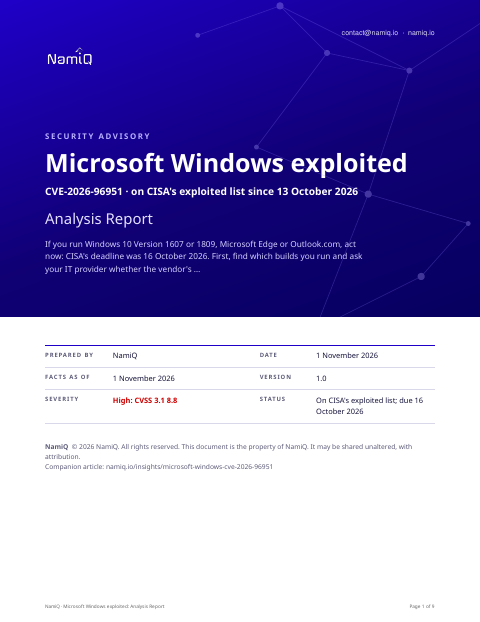 Free analysis report · 9 pagesMicrosoft Windows, CVE-2026-96951: on CISA's exploited listThe same note as a document you can keep or forward: what the sources say, who is affected, and what to do first.Download the analysis report →
At a glance
| Fact | Detail |
|---|---|
| Product | Microsoft Windows (CVE-2026-96951) |
| Severity | High: 8.8 (CVSS 3.1) |
| CISA | On its exploited list since 13 October 2026. Deadline for US federal agencies: 16 October 2026. |
| Chance of exploitation (EPSS) | 0.10, the estimated chance in the next 30 days, as at 1 November 2026 |
| Ransomware use | Not recorded by CISA. That is not the same as none. |
| Fixed in | The record's affected ranges end before 154.0.4258.62, 20260925.100, 10.0.14393.9612, 10.0.17763.9376 |
| Who looks first | Anyone running Windows 10 Version 1607 or 1809, Microsoft Edge (Chromium-based) or Outlook.com, as the record lists them. The record names no further condition. |
Does this apply to you?
| Question | If no | If yes |
|---|---|---|
| Do you run Windows 10 Version 1607 or 1809 on any machine? | Go to the next question about Edge. | Check the build number (next question). |
| Is any of those machines below build 10.0.14393.9612 (1607) or 10.0.17763.9376 (1809)? | Those releases are outside the record's ranges. Nothing more for them. | Treat it as affected and ask your provider to update it now. |
| Do you run Microsoft Edge (Chromium-based) below 154.0.4258.62? | Nothing to do for Edge on this CVE. | Treat it as affected and ask your provider to update it. |
| Does anyone in your firm use Outlook.com for work mail? | Nothing to do for Outlook.com. | Ask your provider or Microsoft support what status the service shows. |
What it is
The record says a flaw in Windows Shell lets an unauthorised attacker, over a network, bypass a security feature by passing special characters into a command without proper checking. It does not say which feature is bypassed.
Why it matters
Our reading is that a way past a security feature, reachable over a network, lets an attacker skip a check that was meant to stop them. The record does not say which feature, or how an attack runs. The affected list covers a browser, a mail service and two named Windows 10 releases, so exposure may be wide. With no vendor advice read, applying the vendor's update is the only sure answer.
Exposure by situation
These priorities are our judgement from what the sources say about who can use the flaw and how. They are not vendor ratings.
| Your situation | Priority | Timeframe |
|---|---|---|
| A Windows 10 Version 1607 or 1809 machine below the build numbers in the record | High | Now; CISA's deadline has passed |
| Edge (Chromium-based) below 154.0.4258.62 on staff laptops | High | Now; CISA's deadline has passed |
| Staff who use Outlook.com for work mail | Medium | This week; ask for the service status |
| Other Windows releases not named in the record | Low | Next patch cycle; confirm with your provider |
| No Windows 10 1607 or 1809, no Edge, no Outlook.com | None | None for this CVE |
Things people will get wrong
- "It only bypasses a security feature, so it is minor." The record scores it 8.8 on CVSS 3.1, and CISA lists it as exploited. The record does not say which feature is bypassed, so you cannot judge the damage.
- "Our Windows is not in the list, so we are safe." The record names only two Windows 10 releases, but it also names Edge and Outlook.com. Check all of them before you stop.
- "A command injection needs someone to log in first." The description says an unauthorised attacker, over a network. The record names no login requirement.
How we would triage it
This is our judgement.
Step 1: Find the versions you run
- List every Windows 10 machine and note whether it is Version 1607 or 1809, and its build number.
- Find the Edge version on staff machines, because the record gives a fixed build boundary for it.
Step 2: Reduce exposure while you wait
- Ask your provider which of these machines can be reached from the internet or by untrusted people, and handle those first.
- CISA says to apply the vendor's mitigations. The vendor's own instructions were not available to us, so ask your provider for them.
Step 3: Apply the vendor's update
- Ask your provider to install the vendor's security update on each affected machine, then restart where needed.
- No source we read names the fixed version, so ask for it in writing.
Step 4: Check and record
- Re-run the version checks and compare against the record's ranges.
- Keep the results with the date, in case you need to show what was done.
To close it, read the version from the product itself, not from an old inventory, and save the output with the date. If you cannot update today, write down who owns it, the new date, and what limits exposure until then.
Send this to your IT provider
Copy it, change the names and dates, and send it. It is a draft for you to check, not a template tested with any provider.
Hello, CISA lists CVE-2026-96951, a command injection flaw in Windows Shell, as exploited, with a deadline of 16 October 2026. Please tell us whether we run Windows 10 Version 1607 or 1809, Microsoft Edge or Outlook.com, and on which machines. Please give the version or build on each. Please also name the fixed version from Microsoft's advisory and confirm in writing that it is installed, by a date you propose. If any machine cannot be updated, please tell us why and what you have done instead. Thank you.
Signs it was used
An update closes the hole. It does not tell you whether someone used it first. CISA's required action points to its forensic triage requirements (BOD 26-04). Look for:
- Unexpected commands started by Windows Shell on affected machines, since the description points to a command being built from unchecked input.
- Network connections to affected machines from unfamiliar sources before they were updated.
The weakness behind it
The record classes this as CWE-77 (Improper Neutralization of Special Elements used in a Command).
The sources, in their words
CISA's catalogue entry:
Microsoft Windows Shell contains a command injection vulnerability that allows an unauthorized attacker to bypass a security feature over a network.
The CVE record, published by Microsoft on 13 October 2026:
Improper neutralization of special elements used in a command ('command injection') in Windows Shell allows an unauthorized attacker to bypass a security feature over a network.
Versions of Microsoft Edge (Chromium-based) the record lists as affected:
- 1.0.0.0 up to, but not including, 154.0.4258.62
The affected ranges end before 154.0.4258.62. Those are the first versions the record does not list as affected; confirm them in the vendor's advisory.
Versions of Microsoft Outlook.com the record lists as affected:
- 1.0.0 up to, but not including, 20260925.100
The affected ranges end before 20260925.100. Those are the first versions the record does not list as affected; confirm them in the vendor's advisory.
Versions of Microsoft Windows 10 Version 1607 the record lists as affected:
- 10.0.14393.0 up to, but not including, 10.0.14393.9612
The affected ranges end before 10.0.14393.9612. Those are the first versions the record does not list as affected; confirm them in the vendor's advisory.
Versions of Microsoft Windows 10 Version 1809 the record lists as affected:
- 10.0.17763.0 up to, but not including, 10.0.17763.9376
The affected ranges end before 10.0.17763.9376. Those are the first versions the record does not list as affected; confirm them in the vendor's advisory.
CISA's required action:
Apply mitigations in accordance with vendor instructions, ensuring compliance with CISA’s BOD 26-04 Prioritizing Security Updates Based on Risk (see URL in Notes) guidance and CISA’s “Forensics Triage Requirements” (see URL in Notes).
What we do not know yet
- Which security feature is bypassed, and what an attacker gains once it is bypassed.
- The fixed version for each product. No vendor page was read, and the record lists no unaffected versions.
- How the attack is carried out, and whether it needs a user to click or open anything.
- Whether any workaround exists short of updating.
- We have not tested this against any environment. Versions and scores are as the sources state them and as at 1 November 2026; the vendor's advisory wins where it differs.
- The sections headed "The bottom line", "Does this apply to you?", "What it is", "Why it matters", "Exposure by situation", "Things people will get wrong", "How we would triage it" and "Send this to your IT provider" are our interpretation of the sources, not a statement by CISA or the vendor.