Zammad GmbH Zammad, CVE-2026-102489: on CISA's exploited list
The bottom line
If you run Zammad 6.5 or earlier, act now: CISA's date has already passed. Move to a supported release. If you run 7.0 or later, the vendor says this flaw cannot be exploited there, so you can stop reading.
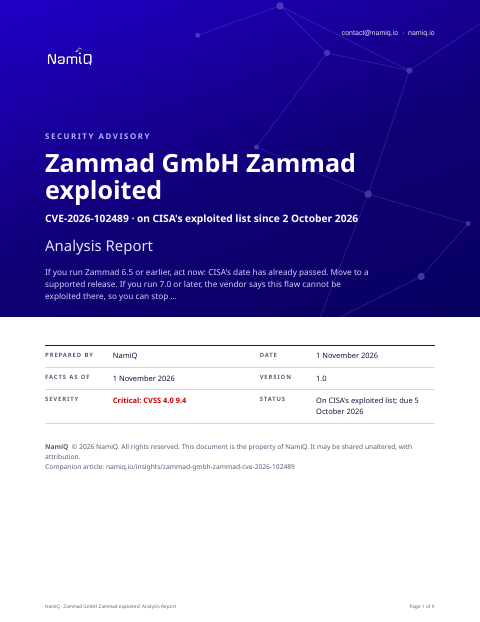 Free analysis report · 9 pagesZammad GmbH Zammad, CVE-2026-102489: on CISA's exploited listThe same note as a document you can keep or forward: what the sources say, who is affected, and what to do first.Download the analysis report →
At a glance
| Fact | Detail |
|---|---|
| Product | Zammad GmbH Zammad (CVE-2026-102489) |
| Severity | Critical: 9.4 (CVSS 4.0) |
| CISA | On its exploited list since 2 October 2026. Deadline for US federal agencies: 5 October 2026. |
| Chance of exploitation (EPSS) | 0.22, the estimated chance in the next 30 days, as at 1 November 2026 |
| Ransomware use | Not recorded by CISA. That is not the same as none. |
| Fixed in | No fix for 6.5 or earlier is named for this CVE. The vendor says 7.0 and later are not affected in practice, with a hardening change in 7.2.0 (advisory, 5 October 2026). |
| Who looks first | Anyone self-hosting Zammad 6.3 to 6.5.x, especially if the helpdesk is reachable from the internet. The vendor says 7.0 and later are not affected in practice. |
Does this apply to you?
| Question | If no | If yes |
|---|---|---|
| Do you run Zammad yourselves (not the vendor's hosted service)? | Nothing to do for this CVE. | Check the version (next question). |
| Is your Zammad version 6.5 or earlier? | The vendor says 7.0 and later are not exploitable. Plan an update to 7.2.0 or later. | Treat it as exposed. Go to the next question. |
| Can anyone outside your organisation reach the Zammad login page? | Lower exposure, but still plan the update from 6.5 or earlier. | Restrict access now, then update. |
| Has anyone untrusted had access to the Zammad server itself? | Continue with the update. | Treat the server as possibly compromised and ask your provider to review it. |
What it is
An attacker can take over a login session (session fixation, CWE-384) and use that to run code on the Zammad server as the zammad user. CISA says it can be chained with CVE-2026-102490, a local privilege escalation.
Why it matters
Our reading: the record gives a score of 9.4 and CISA says the flaw can be chained with CVE-2026-102490. A code-execution foothold paired with a privilege escalation could give an attacker the whole server, and a helpdesk holds customer messages. The vendor says 6.5 and earlier no longer receive routine security updates, so the usual route of waiting for a patch does not apply.
What the vendor's advisory says
We read three pages on zammad.com and community.zammad.org. In short:
- The vendor's advisory of 5 October 2026 says exploitation is only possible on Zammad 6.5 and earlier, because of the runtime environment those versions use.
- The vendor says these versions are out of support and receive no security updates, and says to update immediately if you still run them.
- The vendor says it changed the affected code as extra hardening, included in Zammad 7.2.0.
- The vendor's release list shows Zammad 6.5.5 on 15 October 2026, an exceptional emergency fix for the unsupported 6.5 series. It does not say which flaw this addresses.
- For CVE-2026-102490, the vendor says it is a local privilege escalation that needs prior access to the server, and advises limiting server access to trusted administrators.
Exposure by situation
These priorities are our judgement from what the sources say about who can use the flaw and how. They are not vendor ratings.
| Your situation | Priority | Timeframe |
|---|---|---|
| Zammad 6.5 or earlier, reachable from the internet | High | Now; CISA's window has passed |
| Zammad 6.5 or earlier, reachable only on an internal network | High | This week |
| Zammad 7.0 to 7.1.x | Low | Next patch cycle |
| Zammad 7.2.0 or later | None | None for this CVE |
| Vendor-hosted Zammad, nothing self-run | None | None for this CVE |
Things people will get wrong
- "Every Zammad install is affected." The vendor says 7.0 and later are not affected in practice. The record also says the bug is not exploitable on 7.0.0 to 7.1.2.
- "It is only a local flaw, so it can wait." The record describes remote code execution. The local escalation is the separate CVE-2026-102490, which CISA says it can be chained with.
- "The old 6.5 series will get a normal fix." The vendor says 6.5 and earlier are out of support. It lists 6.5.5 as an exceptional emergency release and does not link it to this CVE.
How we would triage it
This is our judgement.
The commands only read: they print a version or list what is installed. They come from general knowledge of this kind of product, not from the sources, so check them against the vendor's page before you run them. Words in capitals are for you to fill in.
Step 1: Find the versions you run
- Find every Zammad install, including test servers and old containers.
- Note whether each is 6.5 or earlier, 7.0 and later, or hosted by the vendor.
dpkg -l zammad
rpm -q zammad
docker ps --format '{{.Image}}'
Step 2: Reduce exposure
- Limit who can reach the login page and the underlying server, using a VPN or an allow-list.
- The vendor advises restricting server access to trusted administrators.
Step 3: Update to a supported release
- Update to Zammad 7.2.0 or later, the version the vendor recommends. Do not stay on 6.5 or earlier.
- Back up before updating.
Step 4: Check for signs of misuse
- If an old version was exposed, ask your provider to review the server for unexpected logins, new admin users and unfamiliar processes.
- Ask for written confirmation of the version afterwards.
To close it, read the version from the product itself, not from an old inventory, and save the output with the date. If you cannot update today, write down who owns it, the new date, and what limits exposure until then.
Send this to your IT provider
Copy it, change the names and dates, and send it. It is a draft for you to check, not a template tested with any provider.
Hello. CISA lists CVE-2026-102489 in Zammad as exploited. Could you tell us whether we run Zammad, where, and which version? The vendor says 6.5 and earlier are affected and out of support, and that 7.0 and later are not affected in practice. It recommends 7.2.0. If we run 6.5 or earlier, please restrict access to the server now and plan an update. Please send us written confirmation of the version and the fix by an agreed date, and tell us whether the server needs a compromise check. Thank you.
Signs it was used
An update closes the hole. It does not tell you whether someone used it first. CISA's required action points to its forensic triage requirements (BOD 26-04). Look for:
- Unexpected logins or sessions for admin accounts on a Zammad 6.5 or earlier system.
- Unfamiliar processes or files owned by the zammad user.
- New admin users, changed settings or unexpected outbound connections from the server.
The weakness behind it
CISA's entry classes this as CWE-384 (Session Fixation).
The sources, in their words
CISA's catalogue entry:
Zammad GmbH Zammad contains a session fixation vulnerability that can lead to remote code execution as the zammad user. This vulnerability can be chained with CVE-2026-102490.
The CVE record, published by DIVD on 30 September 2026:
Zammad versions 6.3.0 to 6.5.4 are vulnerable a session hijack vulnerability that leads to remote code execution as the zammad user. The bug is also present in version 7.0.0 to version 7.1.2, but not exploitable due to changes in the underlying framework.
Versions of Zammad GmbH Zammad the record lists as affected:
- 6.3.0 up to, but not including, 6.5.4
The affected ranges end before 6.5.4. Those are the first versions the record does not list as affected; confirm them in the vendor's advisory.
CISA's required action:
Apply mitigations in accordance with vendor instructions, ensuring compliance with CISA’s BOD 26-04 Prioritizing Security Updates Based on Risk (see URL in Notes) guidance and CISA’s “Forensics Triage Requirements” (see URL in Notes).
What we do not know yet
- Which exact version first fixes this CVE on the 6.5 line: the sources do not link 6.5.5 to it.
- Whether 6.5.4 is affected: the record's range excludes it, but its description includes it.
- Which flaw Zammad 7.2.2, the packager.io package fix, addresses; the sources do not link it to this CVE.
- How attackers are using the flaw in practice: the sources give no detail.
- We have not tested this against any environment. Versions and scores are as the sources state them and as at 1 November 2026; the vendor's advisory wins where it differs.
- The sections headed "The bottom line", "Does this apply to you?", "What it is", "Why it matters", "Exposure by situation", "Things people will get wrong", "How we would triage it" and "Send this to your IT provider" are our interpretation of the sources, not a statement by CISA or the vendor.
Sources
- CISA Known Exploited Vulnerabilities catalogue
- CVE record for CVE-2026-102489
- FIRST: Exploit Prediction Scoring System
- Advisory or release notes read: zammad.com/en/advisories/cve-2026-102489-cve-2026-102490
- Advisory or release notes read: community.zammad.org/t/take-care-local-privilege-escalation-cve-2026
- Advisory or release notes read: zammad.com/en/product/releases/
- Reference in the CVE record: csirt.divd.nl
- Reference in the CVE record: csirt.divd.nl