Daily CVE highlight, 15 November 2026: 3 new critical CVEs worth reading
The bottom line
3 new records scored 8.5 or higher and nothing says yet that anyone is using them. If you run any of these products, check the version today.
120 CVE records were published in the last 30 hours. 22 scored 8.5 or higher. 3 are below, chosen by a fixed rule: highest score first, then fewest conditions in the wording, one product each. None is on CISA's exploited list, so a score here is the record's author describing the worst case. Read the condition before you act on the number.
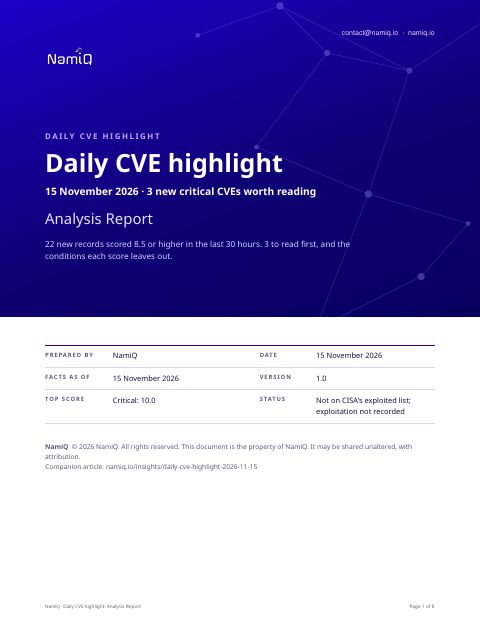 Free analysis report · 8 pagesDaily CVE highlight, 15 November 2026: 3 new critical CVEs worth readingThe same note as a document you can keep or forward: what the sources say, who is affected, and what to do first.Download the analysis report →
At a glance
| Product | Score | Fixed in | Read next |
|---|---|---|---|
| TRENDnet TEW-657BRM (CVE-2026-129351) | 10 (CVSS 4.0) | See the note | Technical Analysis |
| D-Link DIR-600L (CVE-2026-129353) | 10 (CVSS 4.0) | See the note | Technical Analysis |
| D-Link DSL-6740C (CVE-2026-129444) | 10 (CVSS 4.0) | See the note | Technical Analysis |
TRENDnet TEW-657BRM, CVE-2026-129351
If you still have a TRENDnet TEW-657BRM in use, plan to replace it: the vendor says it has been out of support for more than 15 years and no fix is recorded. First, find it and make sure its web interface cannot be reached from the internet. If you have none, you can stop reading.
Score 10 (CVSS 4.0), published by VulDB on 14 November 2026. Weakness: CWE-787, CWE-119.
A word search of the record found none of the usual conditions (privileges, a logged-in user, a non-default setting, local network, physical access, a click). That is a search, not a reading, so read the record yourself before you rule it out.
D-Link DIR-600L, CVE-2026-129353
Act if you run a D-Link DIR-600L router on firmware 2.17 or 2.17b02; the record says a working exploit is public. First, find whether any such router is in use and on that firmware. If you run no D-Link DIR-600L, you can stop here.
Score 10 (CVSS 4.0), published by VulDB on 14 November 2026. Weakness: CWE-121, CWE-119.
A word search of the record found none of the usual conditions (privileges, a logged-in user, a non-default setting, local network, physical access, a click). That is a search, not a reading, so read the record yourself before you rule it out.
D-Link DSL-6740C, CVE-2026-129444
If you use a D-Link DSL-6740C on firmware 20131126, act this week, because no source names a fixed firmware. First, make sure nobody outside your network can reach the router's FTP service. If you do not use this model, you can stop reading.
Score 10 (CVSS 4.0), published by VulDB on 15 November 2026. Weakness: CWE-798, CWE-259.
A word search of the record found none of the usual conditions (privileges, a logged-in user, a non-default setting, local network, physical access, a click). That is a search, not a reading, so read the record yourself before you rule it out.
Fifteen minutes this morning
- List the products above you run. If none, you are done.
- For each one you run, read the version from the product and compare it to the fixed version in the table.
- If it is in range, follow the note: reduce exposure first, then update.
- Book the update, and write down who owns it and by when.
Check your own project
If you build software, you can compare what a project declares with these CVEs from a terminal. The tool reads requirements files, package.json, Maven, Gradle, Cargo, CMake and Dockerfile files, runs nothing, and only the CVE ids leave your machine. Naming the CVEs needs no key.
lattice-scan project . --cve CVE-2026-129351,CVE-2026-129353,CVE-2026-129444Each row says in-range, outside-range, undetermined or lead, with the file and line. That is evidence about what a manifest declares, not about what runs, and a person decides. The verdicts, the CSV columns and a pipeline recipe are in the guide.
Check the servers you run
The same ids can be checked against a host. Run this on the machine itself, not on the laptop that deploys to it: it reads installed packages (dpkg, rpm or apk), snaps, the hardware (maker, model, firmware), the running container images with their operating system and packages, and the kernel version, compares them on the spot, and only the CVE ids leave the machine; the inventory stays on it, in ~/.lattice-scan. Naming the CVEs needs no key. Do it on each server after a deployment, and again when a new entry lands.
lattice-scan --cve CVE-2026-129351 --cve CVE-2026-129353 --cve CVE-2026-129444A match is a candidate for a person to confirm, not a finding. A distribution can fix a CVE under an unchanged version number, so a match is a candidate; on Debian-family hosts the report also shows whether the package's own changelog names the CVE. By default it opens the images your containers are running and reads their operating system and package list; a deep scan (--deep, a few minutes) opens every local image and the Python, Node, Java and Ruby packages inside them; for what an image declares, use the project check on its Dockerfile.
Guide: namiq.io/lattice/guides/choose-your-channel. MCP server (io.namiq/lattice in the MCP registry): namiq.io/lattice. Package: pypi.org/project/lattice-scan, or namiq.io/apt.
- Which way into Lattice fits your job →The command line, the Claude skill or the MCP server: what each needs, what works without a key and how to read the result.
- Lattice, the MCP server →The public graph the command reads, for AI agents over MCP.
- Install and connect →The signed apt repository, the fingerprint, and the connection commands for each client.
What we do not know yet
- These are new records. A record can change in the first days: scores, versions and wording are as at 15 November 2026. Nothing here has been tested.
- Exploitation is not recorded for any of them. That is not the same as none.