Daily threat watch, 18 November 2026: 7 exploited CVEs added this week, 5 to act on now
The bottom line
Start with REDCap, Apache Axis 1.x and Synology DSM or BeeStation: CISA's date for all three is 21 November 2026. Check Point Gaia and UnrealIRCd with linked servers are already past their 16 November 2026 date, so confirm those too. Puppet Enterprise and LiteLLM can follow.
CISA added 7 vulnerabilities to its exploited list from 12 November 2026 to 18 November 2026. 5 have a deadline within three days or already past, 2 of them past.
Separately, 1685 new CVE records were published in the last 30 hours, 340 of them scored 8.5 or higher. They are in the day's CVE highlight, not on this list, because nothing says yet that anyone is using them.
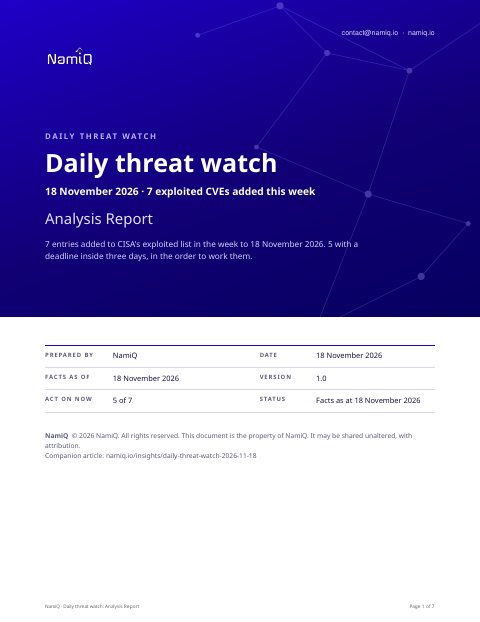 Free analysis report · 7 pagesDaily threat watch, 18 November 2026: 7 exploited CVEs added this week, 5 to act on nowThe same note as a document you can keep or forward: what the sources say, who is affected, and what to do first.Download the analysis report →
What changed since the last watch
- New: Vanderbilt University Research Electronic Data Capture (REDCap), CVE-2026-90817; Apache Axis, CVE-2026-90436; BerriAI LiteLLM, CVE-2026-40217; Synology DiskStation Manager (DSM), CVE-2024-10441.
- Left the seven-day window (31): CVE-2026-116606, CVE-2026-111560, CVE-2026-124194, CVE-2026-20320, CVE-2026-125350, CVE-2026-111793, CVE-2026-123158, CVE-2026-116779, CVE-2026-123218, CVE-2026-102895, CVE-2026-19868, CVE-2026-119977, CVE-2024-27834, CVE-2026-111357, CVE-2026-118527, CVE-2026-97229, CVE-2026-76418, CVE-2026-46300, CVE-2026-41709, CVE-2026-111497, CVE-2026-48356, CVE-2026-109618, CVE-2026-109619, CVE-2026-104935, CVE-2026-59309, CVE-2026-59310, CVE-2026-47876, CVE-2026-41703, CVE-2024-27833, CVE-2024-27851, CVE-2024-27808.
Four entries are new since the watch of 17 November 2026: REDCap, Apache Axis, LiteLLM and Synology DSM (CVE-2026-90817, CVE-2026-90436, CVE-2026-40217, CVE-2024-10441). 31 entries left the week. No deadline has passed since that watch.
At a glance
| Entry | Act | CISA date | Fixed in | EPSS |
|---|---|---|---|---|
| Check Point Multiple Products (CVE-2026-123039) | Today | 2 days past CISA's deadline | Not stated; see the note | 0.02 |
| UnrealIRCd (CVE-2026-114713) | Today | 2 days past CISA's deadline | UnrealIRCd 6.2.7.1 (vendor release, 7 November 2026), or the vendor's hot-patch bundle-20261107 that needs no restart. | 0.00 |
| Vanderbilt University Research Electronic Data Capture (REDCap) (CVE-2026-90817) | Today | Due in 3 days | REDCap 16.0.49 LTS, 17.3.10 LTS or 17.4.4 Standard Release, as applicable (CVE record; no fix date given) | 0.04 |
| Synology DiskStation Manager (DSM) (CVE-2024-10441) | Today | Due in 3 days | DSM 7.2.2-72806-1, 7.2.1-69057-6, 7.2-64570-4, 7.1.1-42962-7; BSM 1.1-65374 (vendor advisory, first published 5 November 2024) | 0.01 |
| Apache Axis (CVE-2026-90436) | Today | Due in 3 days | Not stated; see the note | 0.01 |
| Perforce Puppet Enterprise (CVE-2026-115731) | Next patch cycle | Due in 13 days | Puppet Enterprise 2023.8.13, 2025.12.1 or 2026.0.1 (these bundle puppet-agent 8.22.2 or 9.1.3), then restart puppet server. The record says so; no vendor page was read. | 0.01 |
| BerriAI LiteLLM (CVE-2026-40217) | Next patch cycle | Due in 14 days | Not stated; see the note | 0.17 |
How the week connects
REDCap and Puppet Enterprise share CWE-94, code generation. Axis, LiteLLM, Synology and Puppet also end with code running on the server, by different routes. Check Point needs a local login and UnrealIRCd needs linked servers. Otherwise the products are unrelated.
Do this today, in this order
- Check Point Multiple Products, CVE-2026-123039, 2 days past CISA's deadline. A logged-in local user can get root on Check Point Gaia through a world-writable socket. It matters most where a low-privilege or contractor login could be stolen. No fixed version is recorded.
- UnrealIRCd, CVE-2026-114713, 2 days past CISA's deadline. Any user on a network with two or more linked UnrealIRCd servers can inject server commands. It matters only if you run linked servers. The vendor calls it the critical one of nine issues fixed in 6.2.7.1.
- Vanderbilt University Research Electronic Data Capture (REDCap), CVE-2026-90817, due in 3 days. Code execution on a REDCap server with no login, through a route not meant for public surveys. The attacker needs a valid public survey hash. Anyone running REDCap 13.3.0 or later should look.
- Synology DiskStation Manager (DSM), CVE-2024-10441, due in 3 days. Remote code execution on Synology DSM and BeeStation OS with no login. How it is reached is not published. The vendor's advisory says there is no mitigation, so updating is the only listed fix.
- Apache Axis, CVE-2026-90436, due in 3 days. Code execution in Apache Axis 1.x with no login, through a crafted SOAP fault, if a suitable class is on the classpath. The record says it may be end-of-life. No fixed version is recorded.
The first hour:
- List where REDCap, Apache Axis 1.x, Synology DSM or BeeStation and Check Point Gaia run, with their versions. Do this before anything else.
- Synology: update to the fixed DSM or BSM version. REDCap: upgrade to 16.0.49, 17.3.10 or 17.4.4. Both are due 21 November 2026.
- Axis 1.x: no fix is recorded, so cut off its network exposure. Check Point: apply the vendor's mitigations. UnrealIRCd with linked servers: upgrade to 6.2.7.1.
- Then Puppet Enterprise (upgrade, restart puppet server) and LiteLLM (find who holds a key and whether it is reachable from outside).
- Check Point Multiple Products, CVE-2026-123039 →The full analysis, who is affected, and the analysis report.
- UnrealIRCd, CVE-2026-114713 →The full analysis, who is affected, and the analysis report.
- Vanderbilt University Research Electronic Data Capture (REDCap), CVE-2026-90817 →The full analysis, who is affected, and the analysis report.
- Synology DiskStation Manager (DSM), CVE-2024-10441 →The full analysis, who is affected, and the analysis report.
- Apache Axis, CVE-2026-90436 →The full analysis, who is affected, and the analysis report.
In the next patch cycle
- Perforce Puppet Enterprise, CVE-2026-115731, due in 13 days. Any holder of a certificate from the Puppet certificate authority can run code on the Puppet Server. Automatic signing can hand one to an outsider, so check how requests are signed as well as the version.
- BerriAI LiteLLM, CVE-2026-40217, due in 14 days. A logged-in LiteLLM proxy user can run code on the server through a guardrail test endpoint. The researchers' advisory says it runs as the LiteLLM process user, root in the default Docker image.
- Perforce Puppet Enterprise, CVE-2026-115731 →The full analysis, who is affected, and the analysis report.
- BerriAI LiteLLM, CVE-2026-40217 →The full analysis, who is affected, and the analysis report.
Who can skip most of this
You can skip most of this week if you run none of REDCap, Apache Axis, LiteLLM, Synology DSM or BeeStation, Puppet Enterprise, Check Point Gaia or UnrealIRCd. That says nothing about other flaws.
Send this to your IT provider
Copy it, change the names and dates, and send it. It is a draft for you to check, not a template tested with any provider.
Hello, could you confirm whether we run any of these: REDCap (CVE-2026-90817), Apache Axis (CVE-2026-90436), Synology DSM or BeeStation (CVE-2024-10441), Check Point Gaia (CVE-2026-123039), UnrealIRCd (CVE-2026-114713), Puppet Enterprise (CVE-2026-115731) or LiteLLM (CVE-2026-40217)? CISA's date is 21 November 2026 for the first three and 16 November 2026, already past, for the Check Point and UnrealIRCd entries. Please send us, in writing by Friday, each version in use and the fix or mitigation applied, or the date it will be.
Check it yourself in two minutes
Everything above comes from public sources. This command prints CISA's additions in the same period with their due dates:
curl -s https://www.cisa.gov/sites/default/files/feeds/known_exploited_vulnerabilities.json \
  | jq -r '.vulnerabilities[] | select(.dateAdded >= "2026-11-12" and .dateAdded <= "2026-11-18")
    | [.cveID,.dateAdded,.dueDate,.vendorProject,.product] | @tsv' | sort -k2
Run on 18 November 2026 it printed 7 rows, the ones above. A later run may show more.
Check your own project
If you build software, you can compare what a project declares with these CVEs from a terminal. The tool reads requirements files, package.json, Maven, Gradle, Cargo, CMake and Dockerfile files, runs nothing, and only the CVE ids leave your machine. Naming the CVEs needs no key.
lattice-scan project . --cve CVE-2026-123039,CVE-2026-114713,CVE-2026-90817,CVE-2024-10441,CVE-2026-90436,CVE-2026-115731,CVE-2026-40217Each row says in-range, outside-range, undetermined or lead, with the file and line. That is evidence about what a manifest declares, not about what runs, and a person decides. The verdicts, the CSV columns and a pipeline recipe are in the guide.
Check the servers you run
The same ids can be checked against a host. Run this on the machine itself, not on the laptop that deploys to it: it reads installed packages (dpkg, rpm or apk), snaps, the hardware (maker, model, firmware), the running container images with their operating system and packages, and the kernel version, compares them on the spot, and only the CVE ids leave the machine; the inventory stays on it, in ~/.lattice-scan. Naming the CVEs needs no key. Do it on each server after a deployment, and again when a new entry lands.
lattice-scan --cve CVE-2026-123039 --cve CVE-2026-114713 --cve CVE-2026-90817 --cve CVE-2024-10441 --cve CVE-2026-90436 --cve CVE-2026-115731 --cve CVE-2026-40217A match is a candidate for a person to confirm, not a finding. A distribution can fix a CVE under an unchanged version number, so a match is a candidate; on Debian-family hosts the report also shows whether the package's own changelog names the CVE. By default it opens the images your containers are running and reads their operating system and package list; a deep scan (--deep, a few minutes) opens every local image and the Python, Node, Java and Ruby packages inside them; for what an image declares, use the project check on its Dockerfile.
Guide: namiq.io/lattice/guides/choose-your-channel. MCP server (io.namiq/lattice in the MCP registry): namiq.io/lattice. Package: pypi.org/project/lattice-scan, or namiq.io/apt.
- Which way into Lattice fits your job →The command line, the Claude skill or the MCP server: what each needs, what works without a key and how to read the result.
- Lattice, the MCP server →The public graph the command reads, for AI agents over MCP.
- Install and connect →The signed apt repository, the fingerprint, and the connection commands for each client.
What we do not know yet
- Who is using these flaws, and how often. CISA names no attacker and we do not guess one. Ransomware use is as CISA records it; "unknown" means not recorded.
- EPSS is recalculated daily; the figures are as at 18 November 2026 and will have moved. The order is a rule on CISA's dates and EPSS, not a verdict on your estate: check what you run first.
- The bottom line, how the week connects, the first hour, who can skip it and the message are our interpretation of the records, not a statement by CISA or the vendors.