Daily threat watch, 27 November 2026: 18 exploited CVEs added this week, 16 to act on now
The bottom line
CISA added 18 vulnerabilities to its exploited list from 21 November 2026 to 27 November 2026. 16 have a deadline within three days or already past, 2 of them past. Read the exploited list first. It is the work list. Everything else is a reading list.
Separately, 663 new CVE records were published in the last 30 hours, 152 of them scored 8 or higher. They are in the day's CVE highlight, not on this list, because nothing says yet that anyone is using them.
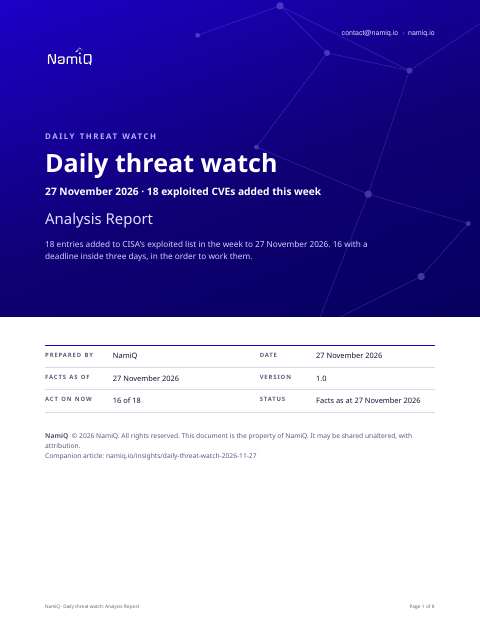 Free analysis report · 8 pagesDaily threat watch, 27 November 2026: 18 exploited CVEs added this week, 16 to act on nowThe same note as a document you can keep or forward: what the sources say, who is affected, and what to do first.Download the analysis report →
What changed since the last watch
- New: Drupal Core, CVE-2026-136716; OSGeo GeoServer, CVE-2026-129243; OSGeo GeoServer, CVE-2026-120705.
- Deadline passed since: N-able MailAssure, CVE-2026-134624; Project MONAI MONAI Label, CVE-2026-133968.
- Left the seven-day window (43): CVE-2026-129448, CVE-2026-123890, CVE-2026-76466, CVE-2025-42884, CVE-2026-90817, CVE-2024-10441, CVE-2026-90436, CVE-2026-115731, CVE-2026-40217, CVE-2026-123039, CVE-2026-114713, CVE-2026-116606, CVE-2026-111560, CVE-2026-124194, CVE-2026-20320, CVE-2026-125350, CVE-2026-111793, CVE-2026-123158, CVE-2026-116779, CVE-2026-123218, CVE-2026-102895, CVE-2026-19868, CVE-2026-119977, CVE-2024-27834, CVE-2026-111357, CVE-2026-118527, CVE-2026-97229, CVE-2026-76418, CVE-2026-46300, CVE-2026-41709, CVE-2026-111497, CVE-2026-48356, CVE-2026-109618, CVE-2026-109619, CVE-2026-104935, CVE-2026-59309, CVE-2026-59310, CVE-2026-47876, CVE-2026-41703, CVE-2024-27833, CVE-2024-27851, CVE-2024-27808, CVE-2026-82384.
At a glance
| Entry | Act | CISA date | Fixed in | EPSS |
|---|---|---|---|---|
| Project MONAI MONAI Label (CVE-2026-133968) | Today | 1 day past CISA's deadline | 0.8.6, released 22 November 2026. The release notes name both a pip package and a Docker image at that version. | 0.27 |
| N-able MailAssure (CVE-2026-134624) | Today | 1 day past CISA's deadline | The record names all builds before 20261121.1943 as affected; 20261121.1943 is the first unaffected build. No vendor advisory page was available to confirm further detail. | 0.02 |
| Drupal Core (CVE-2026-132165) | Today | Due today | Drupal 10.6.22, 11.3.22, 11.4.13 per vendor advisory SA-CORE-2026-017 (18 November 2026). Drupal 8, 9, 10.5.x and below, and 11.2.x and below are end-of-life; no patch is available for them. | 0.08 |
| Idunno AntiCsrf (CVE-2026-131914) | Today | Due today | Not stated; see the note | 0.04 |
| Optimizely Web Experimentation (CVE-2026-132224) | Today | Due today | Optimizely closed the vulnerability on 16 November 2026, the same day as the incident. The record states all versions before 17 November 2026 were affected; no customer installation is needed. | 0.01 |
| Vates Xen Orchestra (CVE-2026-133469) | Today | Due tomorrow | xen-orchestra 6.9.2 (stable) and 6.10.1 (latest); xo-server 5.211.2 and 5.213.1. The record states these versions are fixed. | 0.32 |
| Mitel MiCollab (CVE-2026-133323) | Today | Due tomorrow | Vendor advisory MISA-2026-0012 states a patch is available for MiCollab 10.3 (10.3.0.18). The advisory does not name a later release number; contact Mitel for the exact patch identifier. | 0.06 |
| Danfoss AK-SM 800A Series (CVE-2023-25915) | Today | Due tomorrow | The record's affected range ends below version 3.3, making 3.3 the first version not listed as affected. No vendor advisory could be read to confirm an explicit fix release. | 0.02 |
| Danfoss AK-SM 800A Series (CVE-2023-25914) | Today | Due tomorrow | The record lists affected versions as those below 3.3. No vendor advisory was available; no source explicitly names the fixed release. | 0.02 |
| Hewlett Packard Enterprise (HPE) Juniper Session Smart Conductor and Session Smart Router (CVE-2026-103406) | Today | Due tomorrow | Session Smart Conductor 7.0.5, 7.1.7, and 7.2.3 and all subsequent releases, per the record published 28 October 2026. No vendor advisory page was available to confirm further detail. | 0.02 |
| Mitel MiCollab (CVE-2026-133303) | Today | Due tomorrow | The vendor's advisory says a patch is available for release 10.3. The exact patched build number is not in the available source text; contact Mitel or your reseller for the specific package. | 0.01 |
| Mitel MiCollab (CVE-2026-133324) | Today | Due tomorrow | The vendor's advisory says: apply the provided patch for version 10.3 (10.3.0.18), or upgrade to a later release. No specific later version number is named in the advisory. | 0.01 |
| Mitel MiCollab (CVE-2026-133275) | Today | Due tomorrow | The vendor's advisory (MISA-2026-0012) states a patch is available for release 10.3; the advisory text available does not give the exact patched build number. | 0.01 |
| Drupal Core (CVE-2026-136716) | Today | Due in 3 days | Drupal 10.6.23; Drupal 11.3.23; Drupal 11.4.14 (vendor advisory, 25 November 2026). The advisory also requires running update.php after upgrading. | 0.01 |
| OSGeo GeoServer (CVE-2026-120705) | Today | Due in 3 days | The vendor's November 2026 advisory announces GeoServer 3.0.2, 2.28.6, and 2.27.7 as current releases; it does not explicitly state which release first fixed this CVE. | n/a |
| OSGeo GeoServer (CVE-2026-129243) | Today | Due in 3 days | GeoServer 3.0.2, 2.28.6, and 2.27.7, as listed in the vendor's advisory release announcements. | n/a |
| Danfoss AK-SM 800A Series (CVE-2025-41450) | Next patch cycle | Due in 12 days | Version 4.2 of the AK-SM 8xxA Series. The record, published by Danfoss on 8 May 2025, states all versions before 4.2 are affected; 4.2 is the first version outside that range. | 0.04 |
| Mitel MiCollab (CVE-2026-133311) | Next patch cycle | Due in 12 days | The vendor's advisory says a patch is available for MiCollab release 10.3 (10.3.0.18); apply it, or upgrade to a later release. No specific later version number is named in the advisory. | 0.01 |
Do this today, in this order
- Project MONAI MONAI Label, CVE-2026-133968, 1 day past CISA's deadline.
- N-able MailAssure, CVE-2026-134624, 1 day past CISA's deadline.
- Drupal Core, CVE-2026-132165, due today.
- Idunno AntiCsrf, CVE-2026-131914, due today.
- Optimizely Web Experimentation, CVE-2026-132224, due today.
- Vates Xen Orchestra, CVE-2026-133469, due tomorrow.
- Mitel MiCollab, CVE-2026-133323, due tomorrow.
- Danfoss AK-SM 800A Series, CVE-2023-25915, due tomorrow.
- Danfoss AK-SM 800A Series, CVE-2023-25914, due tomorrow.
- Hewlett Packard Enterprise (HPE) Juniper Session Smart Conductor and Session Smart Router, CVE-2026-103406, due tomorrow.
- Mitel MiCollab, CVE-2026-133303, due tomorrow.
- Mitel MiCollab, CVE-2026-133324, due tomorrow.
- Mitel MiCollab, CVE-2026-133275, due tomorrow.
- Drupal Core, CVE-2026-136716, due in 3 days.
- OSGeo GeoServer, CVE-2026-120705, due in 3 days.
- OSGeo GeoServer, CVE-2026-129243, due in 3 days.
- Project MONAI MONAI Label, CVE-2026-133968 →The full analysis, who is affected, and the analysis report.
- N-able MailAssure, CVE-2026-134624 →The full analysis, who is affected, and the analysis report.
- Drupal Core, CVE-2026-132165 →The full analysis, who is affected, and the analysis report.
- Idunno AntiCsrf, CVE-2026-131914 →The full analysis, who is affected, and the analysis report.
- Optimizely Web Experimentation, CVE-2026-132224 →The full analysis, who is affected, and the analysis report.
- Vates Xen Orchestra, CVE-2026-133469 →The full analysis, who is affected, and the analysis report.
- Mitel MiCollab, CVE-2026-133323 →The full analysis, who is affected, and the analysis report.
- Danfoss AK-SM 800A Series, CVE-2023-25915 →The full analysis, who is affected, and the analysis report.
In the next patch cycle
- Danfoss AK-SM 800A Series, CVE-2025-41450, due in 12 days.
- Mitel MiCollab, CVE-2026-133311, due in 12 days.
- Danfoss AK-SM 800A Series, CVE-2025-41450 →The full analysis, who is affected, and the analysis report.
- Mitel MiCollab, CVE-2026-133311 →The full analysis, who is affected, and the analysis report.
Check it yourself in two minutes
Everything above comes from public sources. This command prints CISA's additions in the same period with their due dates:
curl -s https://www.cisa.gov/sites/default/files/feeds/known_exploited_vulnerabilities.json \
  | jq -r '.vulnerabilities[] | select(.dateAdded >= "2026-11-21" and .dateAdded <= "2026-11-27")
    | [.cveID,.dateAdded,.dueDate,.vendorProject,.product] | @tsv' | sort -k2
Run on 27 November 2026 it printed 18 rows, the ones above. A later run may show more.
Check your own project
If you build software, you can compare what a project declares with these CVEs from a terminal. The tool reads requirements files, package.json, Maven, Gradle, Cargo, CMake and Dockerfile files, runs nothing, and only the CVE ids leave your machine. Naming the CVEs needs no key.
lattice-scan project . --cve CVE-2026-133968,CVE-2026-134624,CVE-2026-132165,CVE-2026-131914,CVE-2026-132224,CVE-2026-133469,CVE-2026-133323,CVE-2023-25915Each row says in-range, outside-range, undetermined or lead, with the file and line. That is evidence about what a manifest declares, not about what runs, and a person decides. The verdicts, the CSV columns and a pipeline recipe are in the guide.
Check the servers you run
The same ids can be checked against a host. Run this on the machine itself, not on the laptop that deploys to it: it reads installed packages (dpkg, rpm or apk), snaps, the hardware (maker, model, firmware), the running container images with their operating system and packages, and the kernel version, compares them on the spot, and only the CVE ids leave the machine; the inventory stays on it, in ~/.lattice-scan. Naming the CVEs needs no key. Do it on each server after a deployment, and again when a new entry lands.
lattice-scan --cve CVE-2026-133968 --cve CVE-2026-134624 --cve CVE-2026-132165 --cve CVE-2026-131914 --cve CVE-2026-132224 --cve CVE-2026-133469 --cve CVE-2026-133323 --cve CVE-2023-25915A match is a candidate for a person to confirm, not a finding. A distribution can fix a CVE under an unchanged version number, so a match is a candidate; on Debian-family hosts the report also shows whether the package's own changelog names the CVE. By default it opens the images your containers are running and reads their operating system and package list; a deep scan (--deep, a few minutes) opens every local image and the Python, Node, Java and Ruby packages inside them; for what an image declares, use the project check on its Dockerfile.
Guide: namiq.io/lattice/guides/choose-your-channel. MCP server (io.namiq/lattice in the MCP registry): namiq.io/lattice. Package: pypi.org/project/lattice-scan, or namiq.io/apt.
- Which way into Lattice fits your job →The command line, the Claude skill or the MCP server: what each needs, what works without a key and how to read the result.
- Lattice, the MCP server →The public graph the command reads, for AI agents over MCP.
- Install and connect →The signed apt repository, the fingerprint, and the connection commands for each client.
What we do not know yet
- Who is using these flaws, and how often. CISA names no attacker and we do not guess one. Ransomware use is as CISA records it; "unknown" means not recorded.
- EPSS is recalculated daily; the figures are as at 27 November 2026 and will have moved. The order is a rule on CISA's dates and EPSS, not a verdict on your estate: check what you run first.